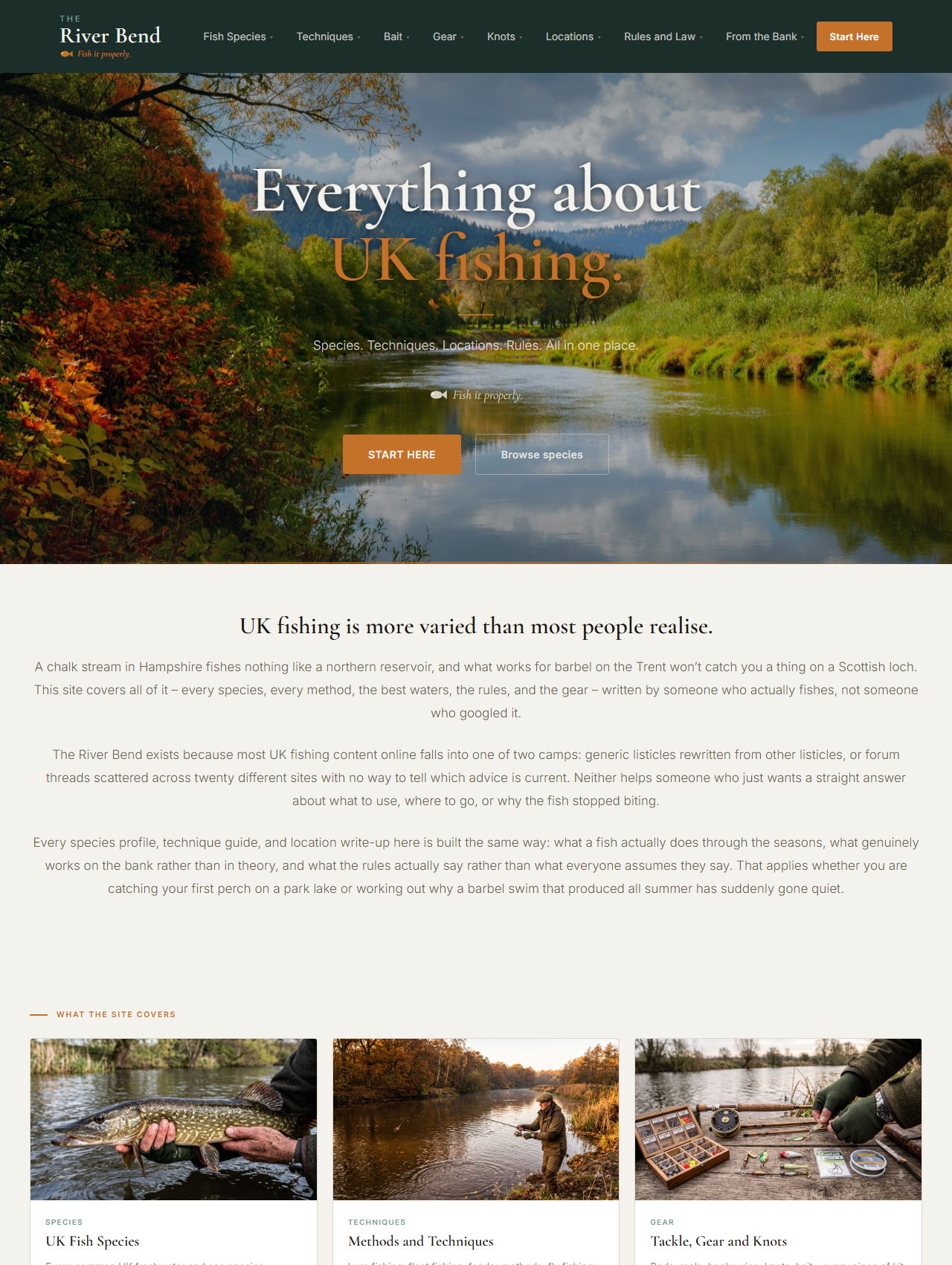
I registered theriverbend.co.uk on 30 June 2026 and built a UK fishing guide site on it. Google showed it for the first time on 2 July. In the 88 days to 27 September it took 340,426 impressions and 3,749 clicks, and it now ranks first for searches it was built to answer.
For the full Riverbend Case Study Please follow : How long does a new website take to rank?
River Bend is my own site, and it carries affiliate links on some guides. That matters to how you read it: I controlled every decision, nothing waited for approval, and there was no brand to trade on.
At a glance
| Site | theriverbend.co.uk |
| Type | New content and affiliate site, UK angling |
| Platform | WordPress |
| Domain registered | 30 June 2026 |
| Period measured | 88 days, to 27 September 2026 |
| Impressions | 340,426 |
| Clicks | 3,749 |
| Average position | 18.6 in week one, 9.1 by month three |
| Pages with at least one impression | 404 |

The problem
A new domain has no history, no links and nothing Google has learned about it. UK angling isn’t an empty subject either. It has long-established forums, magazines, tackle retailers with real budgets, and national bodies holding the informational searches almost by default.
The question was whether planning a content site as a search project from the first line of code, instead of publishing a few posts and hoping, changes how quickly Google responds.
What was built
The site launched as a finished resource instead of a shell that fills up over time. Nine content pillars, each with a hub page and a full dropdown menu, so every guide had a parent and a route from the homepage before a word was written.
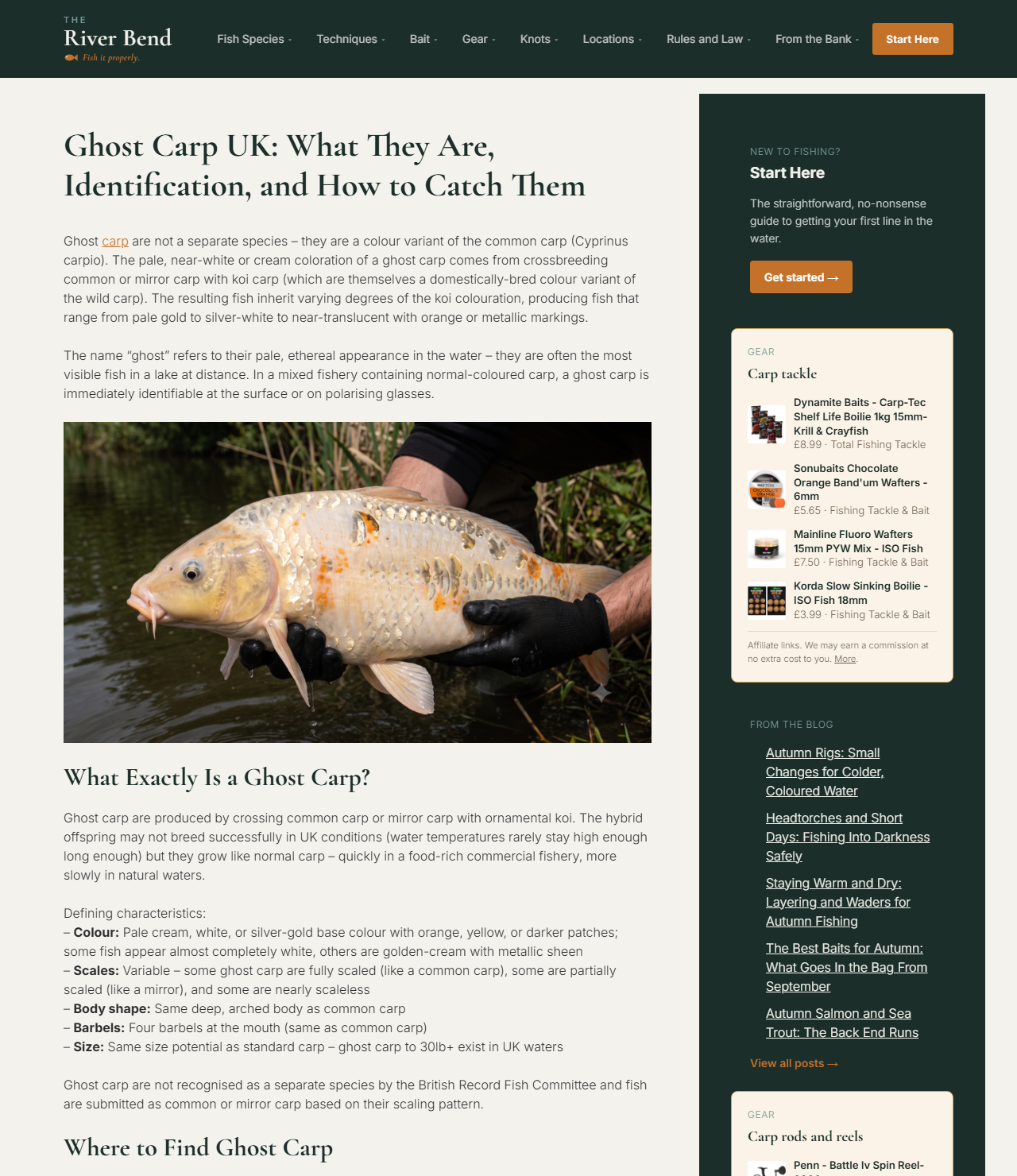
The technical side was deliberately plain: a lightweight WordPress theme, caching, mobile layouts, clean URLs, breadcrumbs and schema on every page.
The decision that mattered most was the publishing pipeline. Each finished guide goes live through the WordPress API with its meta title, description, schema and category already attached, so Google’s first crawl sees a finished page. On most new sites, pages go out in a hurry and get tidied afterwards. That’s the build decision I’d repeat on any content site.
Every guide went through the same writing system I use for client work: a brief, research into what already ranks and what it misses, an outline, a writer pass and a separate editor pass, then checks for voice and sources.
The results
| Period | Clicks | Impressions | Avg position |
|---|---|---|---|
| Week 1 | 11 | 1,071 | 18.6 |
| Month 1 | 202 | 29,578 | 19.9 |
| Month 2 | 1,145 | 120,784 | 12.0 |
| Month 3 (25 days) | 2,402 | 190,064 | 9.1 |
Indexing was quick and traffic was slow. Ninety-two pages had been shown in search within seven days, but the site earned eleven clicks that week. The turn came between months one and two, when clicks went up 5.7 times and the average position improved by nearly eight places.
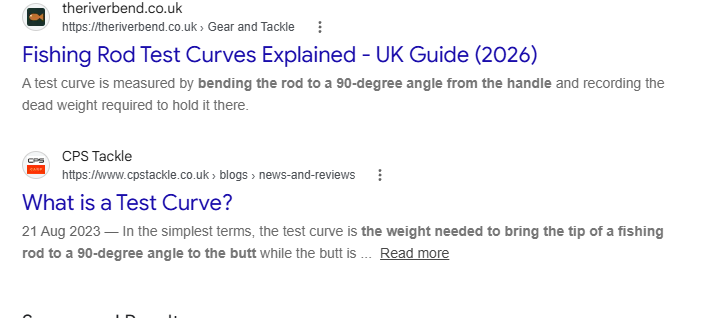
The site now ranks first for “fishing rod test curve explained”, above the established tackle retailers, and is cited inside the AI Overview on the same search.
Three things worth knowing
Depth on specific subjects beat breadth. The river guides led from week one and never stopped. A guide to one named river is specific enough to answer properly, and the competition is mostly forum threads.
Seasonal pages outperformed everything. Four autumn guides sit between positions 3.5 and 4.7 and convert at up to nine times the site average. Publishing against a subject’s calendar, with weeks of lead time, is worth more than it sounds.
New content is orphaned by default. An audit found eleven gear guides in neither the gear menu nor the gear hub. Rebuilding that menu brought 22 pages back into reach, and the orphan check now runs after every batch.
Limitations
Eighty-eight days is a strong start and not a finished result. It’s my own site, so nothing waited for approval. Angling is seasonal and this period covers summer into early autumn only. There’s no control group, so nothing here isolates which decision caused what. No revenue figures are included.
The full data
The complete write-up has the week-by-week and month-by-month breakdown, the rank band tables, all four charts, the AI Overview screenshots and an explicit account of what the data cannot support. It’s in how long a new site takes to rank.
Services used
This project draws on WordPress website builds, content strategy and schema markup. It sits in the publishers and affiliate sites industry. For a very different kind of site, the Barlows Caravan Park case study covers a local business instead of a content project.
FAQ
How long does a new website take to get traffic from Google?
On this site, two days to the first impression and about a week before most pages had been shown, but two months before daily clicks reached double figures reliably. Indexing is fast and earning clicks is the slow part. The full breakdown is in how long a new site takes to rank.
Does a new site need backlinks before it can rank?
Not before it can earn visibility. River Bend reached 340,426 impressions and an average position of 9.1 in 88 days with no link-building campaign. Links would likely have made it faster and matter more for genuinely competitive terms.
Is WordPress good for SEO?
It’s perfectly capable when set up carefully. Clean URLs, custom titles and descriptions, schema and fast hosting are all straightforward. The problems usually come from heavy themes, plugin sprawl and pages published without structure or internal links.
Want a site that grows like this?
If you’re starting from scratch or rebuilding, get in touch and I’ll tell you what I’d plan first, or ask for a free assessment of your current site.