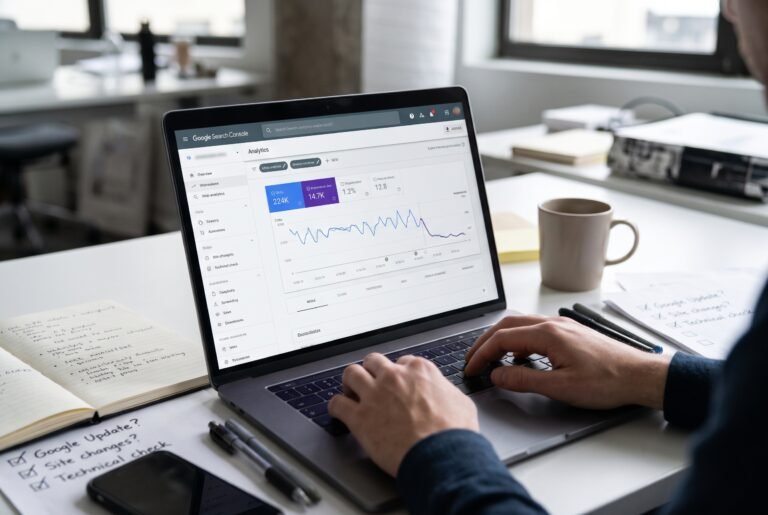
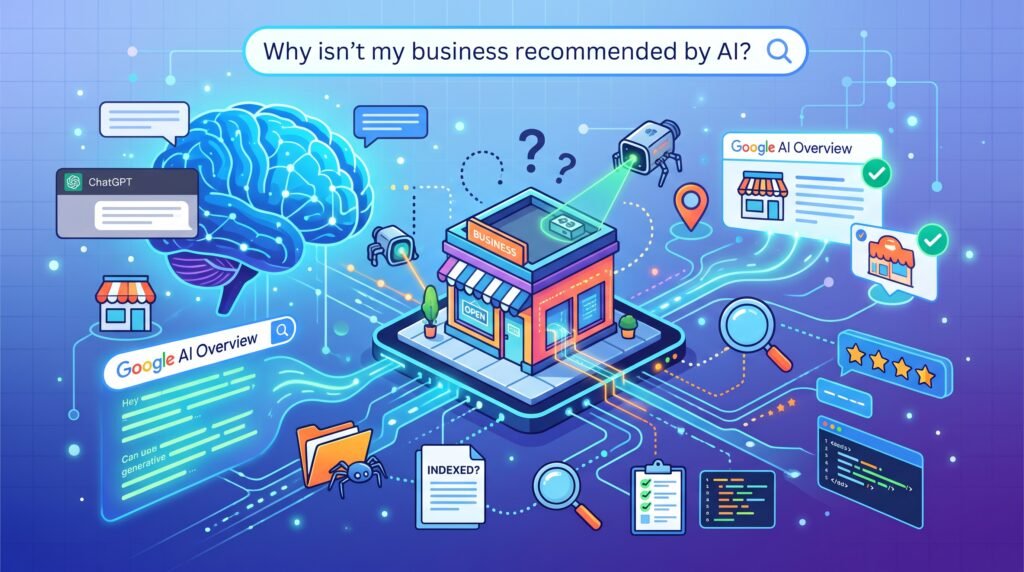
If ChatGPT or Google’s AI results don’t seem to mention your business, the first thing I’d do is check whether that’s actually true.
Not once. Properly.
AI answers change with the wording, the model and the day, so one screenshot doesn’t tell you much. What matters is whether there’s a pattern.
Then I’d work through the more boring questions.
Can the important pages be found and indexed? Are they easy for crawlers to read? Do they actually answer the thing someone is asking? Is your business described clearly enough for a machine to understand what you do and where you do it?
And if competitors are being mentioned, where are those mentions coming from?
There isn’t a quick trick here. Google itself says the same SEO fundamentals still apply to its AI features, which is another way of saying the basics still matter.
First, check what actually happens
Write down five to ten questions a real customer might ask.
Not just broad category terms like “best SEO consultant”, but the kinds of things someone would genuinely type or ask when they have a problem.
For example:
- who can investigate why my traffic dropped?
- how much does a trailer towing course cost near Farnborough?
- which garage threshold seal is best for a large gap?
- who can modernise an old .NET application?
Then run those in ChatGPT, Google where an AI Overview or AI Mode appears, and perhaps one or two other assistants.
Run them more than once.
Change the wording slightly.
Try them again a few days later.
For each one, note:
- whether your business is mentioned
- whether you’re linked
- how you’re described
- who appears instead
- which sources are cited
One result proves very little.
A repeated pattern across a fixed set of questions starts to tell you something.
That’s how I approach AI visibility for clients. I keep a defined prompt set and run it repeatedly rather than treating a single answer as evidence. The process is explained on my methodology page.
Check the boring technical stuff first
If the page you want referenced isn’t indexed, there isn’t much point worrying about how well it is written.
For Google’s AI features, the ordinary search requirements still apply.
So I’d check:
- is the page indexed?
- is it blocked by robots.txt?
- does it have a noindex tag?
- does it return the right status?
- is the useful content actually present when the page is rendered?
Google’s guidance on AI features in Search says there are no special technical requirements beyond the normal eligibility needed to appear in Search.
Other assistants have their own crawlers and rules, so I’d also look at robots.txt, CDN settings and security rules if there’s any chance a bot is being blocked accidentally.
But I wouldn’t jump straight to that explanation.
Most of the time, the content itself is the more interesting question.
Does the page actually answer what someone asked?
This sounds obvious, but plenty of pages don’t.
They talk about the company.
They talk about experience.
They talk about values.
And somewhere halfway down, they might finally answer the actual question.
If someone asks, “how much does this cost?”, the useful page is the one that explains what affects the price.
If they ask, “who is this service for?”, the useful page says so clearly.
If they ask, “which supplier should I choose?”, the page needs to give them evidence, not just adjectives.
I’d look at the page you want mentioned and ask:
Could a sentence or paragraph from this page stand on its own as a useful answer?
If not, a competitor with a clearer explanation is easier to use.
Is your business described clearly?
This matters more than people think.
If your website says one thing, your directory profiles say another, and your Google Business Profile uses different wording again, the overall picture gets messy.
I’d make sure the basics are consistent:
- business name
- what you do
- who you do it for
- where you operate
- who is behind the business
- how to contact you
And I’d make sure the important bits exist as text, not only in a logo or image.
Structured data can help machines interpret those facts, but it doesn’t rescue vague content.
Clarity comes first.
What are competitors doing that you aren’t?
This is where the answer often gets more interesting.
Look at the businesses that are being named.
Are they cited from their own sites?
Directories?
Industry articles?
Review sites?
Forums?
Local press?
Comparison pages?
I wouldn’t pretend there’s a published formula showing exactly how much each type of source matters. There isn’t.
But if the same competitor keeps appearing across several answers, and they also have strong third-party mentions in places you don’t, that’s worth paying attention to.
The useful question is not “how do I copy their AI strategy?”
It’s “what evidence about them exists online that doesn’t exist for us?”
Make sure AI visibility is actually the problem
Sometimes it isn’t.
In one driver training investigation, the business was being named first in the AI summaries I checked for its towing searches.
That looked good.
The weaker area was the map results, where competitors were appearing and the client wasn’t.
So if you only looked at the AI answer, you could easily conclude everything was fine.
The search result as a whole told a different story.
On the other side, GaraDry is currently a good example of the combination working well. It’s named first in the AI Overview for “best garage door threshold seal” and also ranks first in the standard results underneath.
The GaraDry case study has more detail.
That’s why I wouldn’t treat “AI visibility” as a separate world.
It sits alongside normal organic results, maps, paid listings and everything else a buyer sees.
The order I’d work through it
I’d keep it simple:
- Build a small set of real customer questions.
- Run them repeatedly and record what happens.
- Fix any indexing, blocking or rendering issues.
- Improve the pages so they answer those questions clearly.
- Make sure the business itself is described consistently.
- Look at where competitors are being mentioned away from their own sites.
- Repeat the same prompt set every month.
What I wouldn’t do is chase some special AI-only trick.
Google says there’s no special markup or file required for its AI features.
So I wouldn’t spend much time looking for a magic llms.txt fix or a hidden tag that supposedly unlocks AI visibility.
I’d spend it on pages that are useful, specific and easy to understand.
The short version
If your business isn’t being mentioned in ChatGPT or Google’s AI results, ask:
- Is that really happening consistently?
- Can the important pages be crawled and indexed?
- Do those pages actually answer the questions buyers ask?
- Is the business described clearly and consistently?
- Are competitors being mentioned in places you’re not?
- Is AI visibility even the main problem?
That usually gets you much closer to something you can actually act on.
If you want me to check this for your business, my AI search visibility service covers the testing and tracking, and the free assessment includes a first look at a few key questions.
You can also get in touch.
FAQ
Why doesn’t ChatGPT recommend my business?
Often because it has little clear information about you to draw on, or competitors have more of it. I’d check the key pages are indexed and answer customer questions plainly, then look at where competitors are mentioned that you aren’t.
How do I get my business into Google AI Overviews?
There’s no separate route. The same SEO fundamentals apply: pages indexed, eligible to show a snippet, and answering the question clearly. A page that’s trusted in ordinary search stands a better chance of being used.
Do I need an llms.txt file?
Not for Google, which says no special files or markup are needed. It might be an optional extra for other platforms, but I wouldn’t spend time on it before fixing the pages themselves.
How do I check whether AI assistants mention my business?
Write down the questions your customers ask and run each one several times across the main assistants. Note whether you were mentioned, linked or replaced by a competitor, then repeat monthly. One check proves very little because answers vary.
Can I pay to be recommended by an AI assistant?
Not for a place in the answer itself. The work is making your pages the clearest answer to the question and measuring how often you’re named.
Sources
- AI features and your website, Google Search Central, accessed 21 October 2026. Supports: pages must be indexed and eligible to appear with a snippet, the same SEO best practices apply and no special markup is needed.
- Paul Myers, traffic investigation for a local driver training business, 2026 (published case study, client details withheld). Supports: the AI summary naming the business first while the map results did not.
- Paul Myers, GaraDry AI Overview result, 2026 (published case study). Supports: the named first and ranking first example.