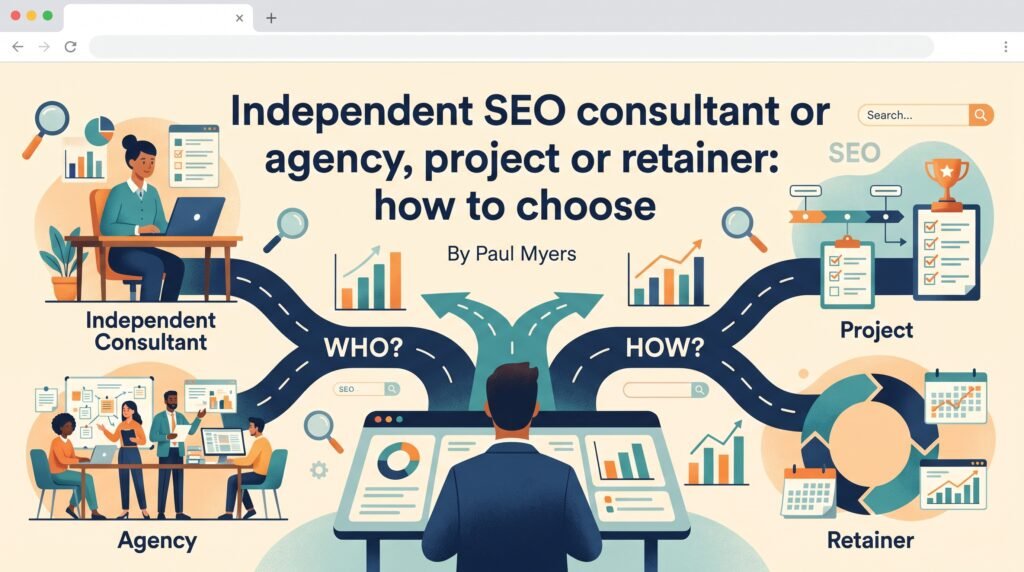
There are really two decisions here, and people often bundle them together.
Who do you want doing the work: an independent consultant, an agency or someone in-house?
And how do you want to buy the work: as a one-off project, ongoing monthly support or occasional advice?
I’m an independent consultant, so I’m obviously one of the options you might be comparing. This is how I’d think about it if I were buying SEO myself.
When an independent consultant makes sense
Usually when you want direct access to the person doing the work and you already have people who can implement some of it.
That’s probably the biggest difference.
There’s no hand-off from a sales call to an account manager and then on to someone else doing the analysis. You know who is looking at the site and who is making the recommendations.
It can also keep the setup leaner if you already have a developer, writer or marketing team.
In that case, you may not need another team to do everything. You might just need someone to work out what matters, put it in the right order, brief your team properly and check whether it worked.
That’s how I work with a lot of clients.
The obvious downside is capacity.
One person has finite time. If you need 30 articles written, a redesign, outreach, technical development and work across six countries at the same time, an independent consultant may not be the best setup unless other people are involved too.
When an agency makes more sense
If you want a larger chunk of the work delivered for you.
An agency can bring strategy, content, technical SEO, design, digital PR and account management together under one roof.
That can be useful if your internal team is small, or if you simply don’t want to coordinate several different suppliers.
Larger businesses can also benefit from the extra capacity, cover and process.
The main thing I’d want to understand is who will actually be working on the account.
You may meet a senior person during the pitch and then work day-to-day with someone else entirely.
That isn’t automatically bad. It’s just something I’d want to know before signing.
Freelancers and in-house teams sit somewhere in between
Freelance marketplaces make it very easy to compare rates and profiles.
That can work well for defined tasks, but profiles are still self-reported. I’d want to see examples of the work and, where possible, speak to a client.
An in-house hire gives you someone close to the business every day, which can be a huge advantage.
But hiring takes time, and one person rarely covers technical SEO, strategy, content and implementation equally well.
A lot of businesses end up with a mix.
Someone in-house handles the day-to-day, and a specialist comes in for audits, migrations, strategy, difficult investigations or simply a second opinion.
There’s nothing wrong with that.
Project or monthly retainer?
This is a separate decision.
Some SEO work naturally has an end.
An audit, migration plan, traffic investigation or strategy can usually be scoped as a project. You agree the work, the price and the output beforehand.
Ongoing SEO is different.
If there’s a steady stream of content, technical fixes, reviews and testing, a monthly arrangement often makes more sense because the work doesn’t really stop after one report.
My preference is usually to understand the problem first.
That might mean starting with an audit, investigation or initial piece of strategy, then deciding whether there’s enough useful ongoing work to justify a retainer.
I’d be wary of signing a long monthly contract before anyone has properly looked at the site.
At that point, neither side really knows what the work is going to involve.
For my own work, monthly arrangements have an initial three-month commitment, then continue month to month with one month’s notice.
Project work is priced and agreed beforehand.
The pricing page explains how I structure it.
What should you ask before choosing anyone?
Google has its own guidance on hiring an SEO, and some of it is very sensible.
Ask for examples.
Understand what they’re proposing.
Be cautious of guarantees.
I’d also ask:
- who will actually work on my site
- what will I receive
- what do you expect me or my team to do
- how will you measure whether the work is helping
- what’s the minimum commitment
- what happens if priorities change
- what access do you need
- what won’t you do
That last one is worth asking.
Someone who is comfortable saying “that isn’t my area” is usually more reassuring than someone who claims to cover everything.
Price matters, but scope matters more
It’s difficult to compare SEO prices without knowing what sits behind them.
An independent consultant may have less overhead and fewer people involved.
An agency fee may include account management, specialist teams, reporting and cover.
A project can look expensive in one month but then end.
A retainer spreads the cost, but it also means an ongoing commitment.
So I’d compare what you actually receive for the money rather than the monthly number on its own.
I’ve written more about that in what affects the cost of SEO.
What would I choose?
If I had a developer and someone who could write, I’d probably start with an independent specialist and a defined piece of work.
Find out what actually needs doing first.
If that turns into a steady stream of useful work, move into monthly support.
If I had no internal resource and wanted someone to take the whole thing away, I’d look more seriously at an agency.
And if I wasn’t sure yet, I wouldn’t sign anything long-term.
I’d start with a conversation, an assessment or a small project and see how the person thinks.
That tells you far more than a polished proposal.
If you want me to take a first look, you can request a free assessment or get in touch.
FAQ
Is an independent SEO consultant better than an agency?
Neither is better in general. A consultant gives you direct access to the person doing the work and suits teams that carry out their own changes. An agency has more capacity and suits businesses that want it all delivered. I’d ask who will actually work on your site.
Should I choose an SEO retainer or a one-off project?
I’d usually start with a project, such as an audit, so you know what needs doing. A retainer makes sense once there’s a steady stream of work. I’d avoid a long one before anyone has looked at your site.
How long should an SEO contract be?
There’s no standard. I use a three-month minimum for monthly work, then month to month with a month’s notice. I’d be cautious of long fixed terms with a vague scope, and ask what happens if priorities change.
What should an SEO consultant give me each month?
Things you can check: what was done, what changed in your data and what happens next. I’d be wary of reports that only show rankings or traffic without saying what was done or what it means for enquiries.
Can I work with an independent consultant and my own developers?
Yes, it’s a common arrangement. The consultant works out what needs doing, writes briefs your developers and writers can act on, and checks the result once it’s live.
Sources
- Do you need an SEO?, Google Search Central, last updated 5 June 2026, accessed 21 October 2026. Supports: asking for references, understanding what an SEO will do, and caution about guaranteed rankings.
- Paul Myers, pricing and terms, 2026. Supports: the three-month minimum for monthly work, fixed project prices and one month’s notice.