Most of the AI search advice a UK business gets is really advice about Google. That’s understandable, because Google publishes more about its AI features than anyone else and it still handles the overwhelming majority of searches here. It also leaves a gap, because the assistants people actually use day to day work differently from each other, and from Google.
This is the piece I’d want a client to read before deciding whether “AI visibility” is worth a line in the budget. It covers who answers questions, how each one finds and cites sources, which crawlers they send, and what the available data does and doesn’t tell you.
A warning before we start: there’s far less solid public information here than in the Google documentation. Where I’m relying on a platform’s own documentation, I say so and link it. Where I’m inferring, I say that too.
The five that matter, and how they differ
Five systems answer questions with reference to the live web: Google’s AI Overviews and AI Mode, ChatGPT, Google’s Gemini app, Claude, Perplexity and Microsoft Copilot. They split into two groups, and the split matters more than the brand names.
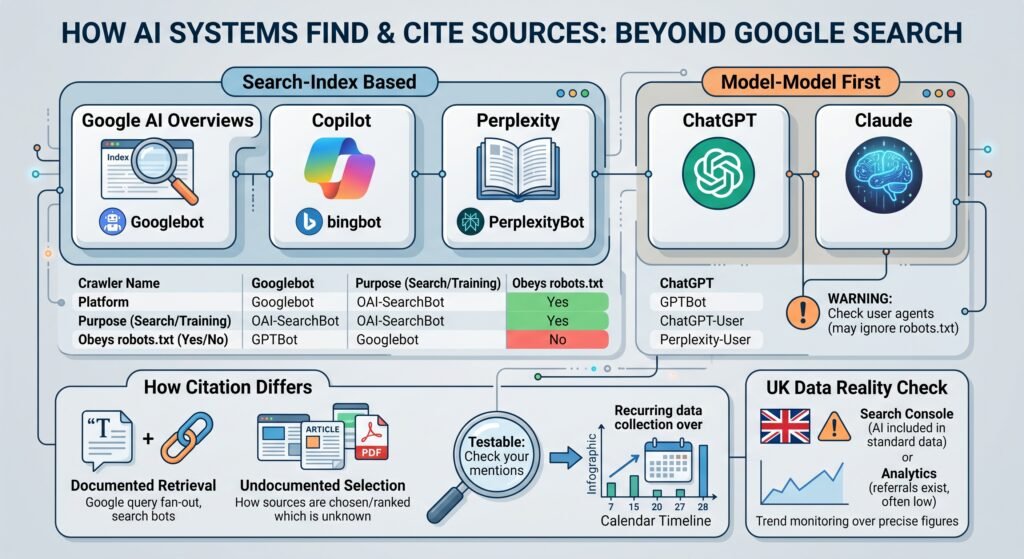
Some answer from a search index. AI Overviews and AI Mode draw on Google Search. Copilot draws on Bing. Perplexity runs its own crawl and index. For these, being findable in the underlying index is the entry requirement.
Others answer from a model, and reach for the web only when the question needs it. ChatGPT and Claude both work this way. A question about something stable and widely documented may be answered without any retrieval at all, which means no citation and no click for anyone. A question about current prices, local suppliers or recent changes is far more likely to trigger a search.
That distinction has a practical consequence. If your customers ask questions with stable answers, the assistant may never visit a website to answer them, and no amount of content work changes that. If they ask questions where the answer moves, retrieval happens, and the sources it reaches for are worth caring about.
Which crawlers each platform sends
This is the most checkable part of the whole subject, because the platforms publish it. It’s also the part most often got wrong in proposals, because the crawlers do different jobs and blocking the wrong one has the opposite effect to the one intended.
| Crawler | Platform | What it’s for | Obeys robots.txt |
|---|---|---|---|
Googlebot |
Search index, which feeds AI Overviews and AI Mode | Yes | |
Google-Extended |
Training and grounding in Google’s other AI products, not Search | Yes | |
OAI-SearchBot |
OpenAI | Surfacing sites in ChatGPT’s search features | Yes |
GPTBot |
OpenAI | Crawling content that may be used to train foundation models | Yes |
OAI-AdsBot |
OpenAI | Validating landing pages for ad compliance, not training | Yes |
ChatGPT-User |
OpenAI | User-initiated browsing, when someone asks and ChatGPT fetches | OpenAI says robots.txt rules may not apply |
PerplexityBot |
Perplexity | Surfacing and linking sites in Perplexity results | Yes |
Perplexity-User |
Perplexity | User-initiated fetches | Perplexity says it generally ignores robots.txt |
bingbot |
Microsoft | Bing index, which feeds Copilot | Yes |
Two things in that table catch people out.
The first is that OpenAI and Perplexity both separate the crawler that gets you into their search from the one that takes your content for training. Blocking GPTBot keeps your content out of model training while leaving OAI-SearchBot free to surface you in ChatGPT search. Plenty of robots.txt files block both, usually because someone pasted a list, and the result is a business that has opted out of being findable in ChatGPT while believing it protected its content.
The second is the user-initiated agents. Both OpenAI and Perplexity state that ChatGPT-User and Perplexity-User may not follow robots.txt, because a person asked for the page. If you want to stop those, robots.txt is the wrong tool and you’re into firewall rules and IP verification. Perplexity publishes its IP ranges for exactly that purpose.
I’d check your robots.txt against this table before doing anything else on this subject. It costs nothing and I find problems in it more often than not.
How citation actually differs between them
Here the public record thins out considerably, and I want to be careful about the difference between what platforms document and what practitioners observe.
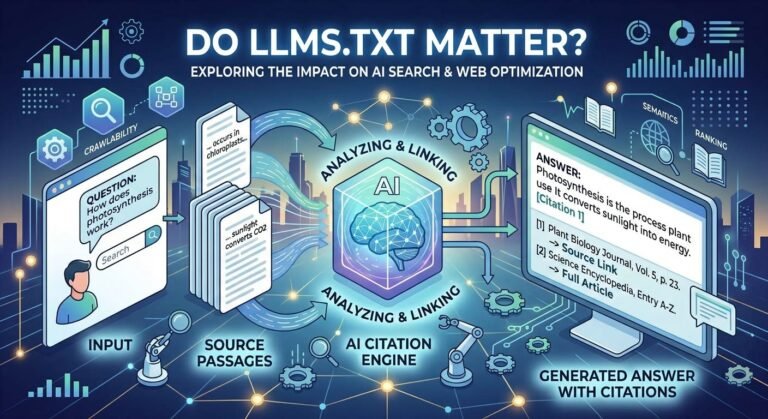
What’s documented: Google describes query fan-out, where a question is broken into subtopics and several searches run at once. Perplexity documents that PerplexityBot exists to surface and link sites in its results. OpenAI documents that OAI-SearchBot surfaces sites in ChatGPT’s search features.
What isn’t documented anywhere: how any of them rank or select between candidate sources. None of the five has published anything comparable to Google’s ranking documentation, and I’d be sceptical of anyone claiming to know the selection criteria for ChatGPT or Claude.
What can be observed, with effort: whether you’re mentioned for a given question, which sources are cited alongside you, and whether the description of your business is accurate. That’s testable. It’s also the only honest basis for a measurement claim, and it needs repeating over time, because answers vary between runs even for the same prompt.
The variability is worth dwelling on, because it undermines a lot of reporting in this area. Ask the same assistant the same question twice and you may get different sources. A single screenshot proves very little. A set of questions, run repeatedly, with the results recorded, tells you something. When I do this for clients that’s the shape of it, and I’d want any supplier’s method to look similar.
What the UK data actually supports
Here’s where I’d caution against the numbers flying around.
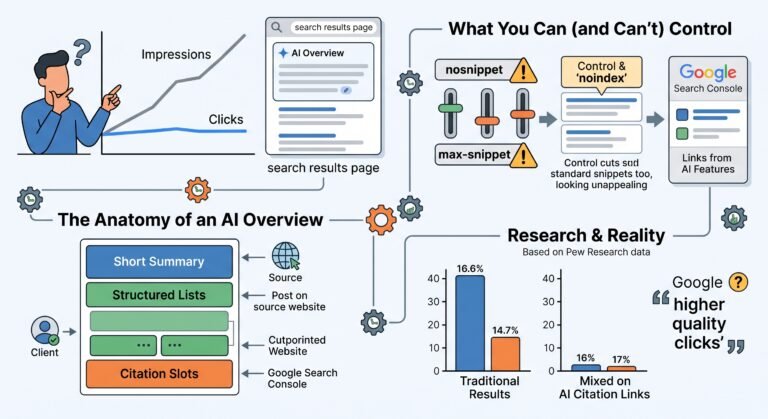
Most published research on AI search behaviour is US data. The Pew Research Center study widely quoted on AI Overviews and clicks used a panel of 900 US adults, with browsing data from March 2025. A fuller analysis by the same researchers followed in August 2026. Both are careful pieces of work and neither is a UK sample.
Google’s AI Overviews reached the UK in August 2024, roughly three months after the US launch, and rollout timing affects how embedded the behaviour is. I wouldn’t assume UK click behaviour matches the US figures, and I wouldn’t assume it’s wildly different either. I don’t have the data to say, and I’ve not seen a UK equivalent of the Pew work.
What you can get for your own business, which is more useful than any market figure:
Search Console shows impressions and clicks together. Links shown in Google’s AI features are reported inside your normal Search performance data, under the Web search type, with no separate AI Overviews breakdown. So you can watch the gap between impressions and clicks widen on particular pages, but you can’t attribute that gap cleanly to AI Overviews.
Analytics shows referrals from assistants where they’re identifiable. ChatGPT, Perplexity and Copilot can send referral traffic that appears in GA4. It’s usually a small number, and I’d treat its absence as weak evidence, because plenty of assistant usage ends without a click at all.
Neither gives you a complete picture. Together they give you a trend you can act on, which is the subject of the next post in this series.
What this means for a UK small business
Three practical positions, based on the above.
If your customers search Google for what you do, Google is still where the work is. The other platforms are worth measuring and worth being accurate in, but the volumes involved don’t yet justify reordering a strategy around them for most small businesses I work with. That’s a judgement based on the client data I see, and someone with a different client base might reasonably disagree.
If your robots.txt blocks the search crawlers, fix that first. It’s the only item on this entire list that’s both free and unambiguous.
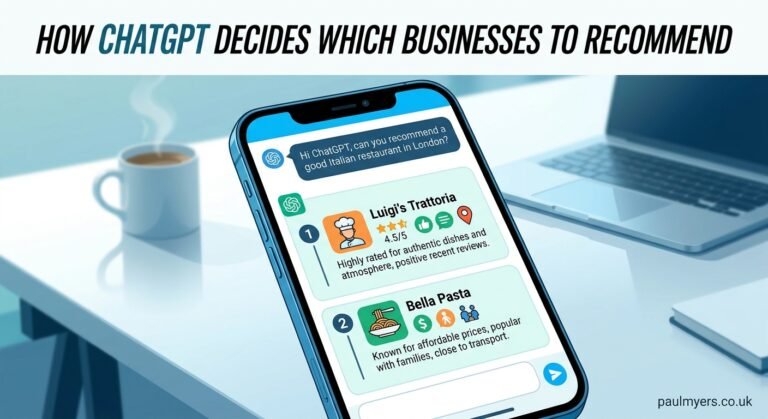
If your business depends on being recommended, as opposed to being found, then assistant visibility matters more than the raw volumes suggest. A question like “who’s a good accountant in Liverpool” produces a short list, and being absent from it is a different problem from ranking eleventh.
What I’d do
Start with the crawler check, because it’s quick and it’s binary. Pull your robots.txt and compare it against the table above. Confirm OAI-SearchBot, PerplexityBot and Googlebot are not blocked. Decide separately whether you want GPTBot and Google-Extended allowed, which is a content licensing question and not an SEO one.
Then write down the ten to fifteen questions a customer would genuinely ask an assistant before buying from you. Not keywords. Questions, in the words they’d use.
Then run them. ChatGPT and Perplexity are the two I’d start with, because they’re the most likely to retrieve and cite. Record whether you’re named, what’s said about you, and which sources get cited instead. Repeat it monthly, because one run tells you almost nothing.
That’s a baseline, and it’s the thing almost nobody has. Once you have it you can tell whether anything you do afterwards made a difference, which is more than most AI visibility reporting can claim.
This is work I do with clients, and there’s more detail at AI search visibility. The AI search guide goes deeper into the mechanics of each platform, and if you want the Google side specifically, what AI Overviews actually are covers that.
FAQ
Which AI assistants actually browse the web?
All five of the main ones can, but not on every question. Google’s AI Overviews, AI Mode, Perplexity and Copilot answer from a search index. ChatGPT and Claude answer from the model and retrieve only when the question needs current or specific information, so a question with a stable answer may produce no citation at all.
Should I block GPTBot in robots.txt?
That depends on whether you object to your content being used in model training, which is a licensing decision and not an SEO one. Blocking GPTBot does not remove you from ChatGPT’s search features. OAI-SearchBot handles that, and it’s a separate token you should leave allowed.
Can I stop AI assistants reading my pages?
Only partly. GPTBot, OAI-SearchBot, PerplexityBot and Google-Extended obey robots.txt. The user-initiated agents don’t reliably: OpenAI says robots.txt may not apply to ChatGPT-User, and Perplexity says Perplexity-User generally ignores it. Blocking those needs firewall rules and IP verification.
Is there UK data on AI search click behaviour?
Not that I’ve found. The widely quoted research, including the Pew Research Center study, uses US panels. AI Overviews reached the UK in August 2024, about three months after the US, so I’d be cautious about transferring US figures directly and equally cautious about assuming they don’t apply.
How do I know if ChatGPT recommends my business?
Test it. Write out the questions a customer would genuinely ask before buying, run them, and record whether you’re named, whether the description is accurate, and which sources are cited. Answers vary between runs, so repeat it monthly. A single screenshot proves very little.
Does AI referral traffic show in Google Analytics?
Some of it. ChatGPT, Perplexity and Copilot can send identifiable referral traffic into GA4. The figures are usually small, and a low number isn’t proof of low visibility, because a lot of assistant usage ends with the answer and no click at all.
Sources and method
- Overview of OpenAI crawlers, OpenAI, accessed 24 September 2026. The
OAI-SearchBot,GPTBot,OAI-AdsBotandChatGPT-Usertokens, what each is used for, and OpenAI’s statement that robots.txt rules may not apply to user-initiated fetches. - PerplexityBot and Perplexity-User, Perplexity, accessed 24 September 2026. Both user-agent tokens, the statement that
PerplexityBotis not used to crawl for foundation models, thatPerplexity-Usergenerally ignores robots.txt, and the published IP ranges for verification. - AI features and your website, Google Search Central, last updated 10 December 2025, accessed 24 September 2026. Query fan-out,
Google-Extendedcovering training and grounding outside Search, and AI feature links being reported within normal Search Console performance data. - Google users are less likely to click on links when an AI summary appears in the results, Pew Research Center, published 22 July 2025, accessed 24 September 2026. The 900-adult US panel and March 2025 data period.
- Investigating Click Behaviors On Google Search Result Pages That Produce an AI Overview, Chapekis, Lieb, Shah and Smith, arXiv:2608.04831, submitted 5 August 2026, accessed 24 September 2026. The fuller analysis of the same panel data.
- AI Overviews, Wikipedia, accessed 24 September 2026. Secondary source for the August 2024 UK rollout date. Check against Google’s own announcements where the date matters.
A note on what isn’t sourced here. No platform publishes how it ranks or selects between candidate sources, so the sections on citation behaviour describe what can be observed and tested, not a documented mechanism. Where I’ve drawn a conclusion from client work I’ve said so in the text.