I should say at the start that I sell this work, so you’re reading a supplier’s guide to buying from suppliers. Read it with that in mind. I’ve tried to write the version I’d want a client to have even when it costs me a sale, partly because it usually doesn’t, and partly because the alternative is the kind of document this article is about.
Most AI search proposals I see fall into one of three groups. A few are good work described plainly. Rather more are ordinary SEO with new labels on it, which isn’t dishonest but should be priced as ordinary SEO. A small number promise things nobody can deliver. Telling them apart is easier than it looks, and it mostly comes down to asking what will actually be done.
Read the deliverables against Google’s own guidance first
This costs you nothing and takes ten minutes.
Google publishes a document called Top ways to ensure your content performs well in Google’s AI experiences on Search, last updated 10 July 2026. It addresses several tactics by name. If a proposal promises them as AI visibility work, the supplier is selling something Google has publicly said doesn’t apply:
- Creating llms.txt or other AI text files. Google says Search doesn’t use them and having one won’t help or hurt.
- Breaking content into small chunks so AI can understand it. Google says there’s no such requirement.
- Rewriting pages in an AI-friendly style. Google says you don’t need to write a particular way for generative AI search.
- Building “mentions” across the web. Google cautions that inauthentic mentions aren’t as useful as they sound.
A companion document, AI features and your website, adds that there are no additional requirements to appear in AI Overviews or AI Mode, and no special schema markup needed.
Two fair caveats before you use this as a weapon. Both documents describe Google. Neither tells you how ChatGPT, Claude or Perplexity choose sources, so a supplier doing genuine work on assistant visibility isn’t contradicted by them. And a proposal containing these items is more often out of date than dishonest. The tactics circulated widely in 2024 and plenty of documents haven’t been revisited since.
What it does tell you is how current the thinking is. If the document still says SGE, it predates May 2024, when Google renamed the feature to AI Overviews.
The questions that separate method from pitch
Five, and they’re all reasonable to ask in a first conversation.
What exactly will you do, in plain English? Not “optimise for generative engines”. Something like “test forty questions across ChatGPT and Perplexity each month, record whether you’re named and which sources are cited, and rewrite the six pages that answer them worst”. If a supplier can’t produce that sentence, there may not be a method underneath.
Which platforms, and which surface? AI Overviews and AI Mode are different surfaces and Google says they may use different models and techniques. ChatGPT, Claude and Perplexity are different again. A proposal saying “AIO” could mean work across every assistant or work on one Google feature, and the price difference between those should be substantial.
How will we know if it worked? The honest answers are specific and limited: assistant mentions for an agreed question set, tracked over time; AI referral traffic in analytics where identifiable; impressions against clicks in Search Console. All three have caveats and a good supplier will volunteer them.
What’s your baseline? If nobody records where you started, nobody can show movement later. This is the most commonly missing item in the proposals I get shown, and it’s the one that makes everything else unfalsifiable.
Which of this is already in our SEO scope? Ask it directly. There’s nothing wrong with the answer being “most of it”, and a supplier who says so is more trustworthy than one who insists it’s all new.
What a fair scope looks like
I’m not going to quote you a price, and I’d be wary of anyone who quotes one before understanding your business. What this work costs depends on how many questions matter, how many platforms are worth tracking, what state the site is in and what needs writing afterwards. Those are things that come out of a conversation, not a rate card.
What you can judge, before any number is discussed, is whether the scope makes sense. There are broadly three levels.
A baseline and a diagnosis, done once. A crawler check, a set of questions tested across two or three assistants, a record of what’s currently said about the business, and a prioritised list of what to fix. This is where I’d start most small businesses, because it’s the thing that makes everything afterwards measurable.
Ongoing work, where that baseline is repeated on a regular cycle, the pages that answer badly get rewritten, and the technical and content work underpinning ordinary search visibility carries on alongside. Most of the effort at this level is regular SEO, and the proposal should say so plainly.
Depth, for a business where being recommended genuinely drives revenue. A larger question set, tracking across more platforms, competitor comparison, source analysis to understand who gets cited instead of you, and substantial content work following from it.
Whatever the number attached, ask which of those three you’re buying. A proposal that charges a separate premium for AI search while describing work that’s mostly technical SEO and content is asking you to pay twice for the same thing, and that’s true at any price.
What nobody can promise
Five things, and any of them in writing should end the conversation.
Guaranteed appearance in AI Overviews. Google states there are no special optimisations for inclusion, and no supplier controls the ranking systems behind it.
Guaranteed ChatGPT or Perplexity recommendations. Nobody outside those companies knows the selection criteria, and none of them has published it.
A definitive list of AI ranking factors. Google’s own documentation says AI Mode and AI Overviews may use different models and techniques and that results will vary. There’s no published list to buy.
A precise figure for what AI search has cost you. Google doesn’t report AI Overview impressions separately, so this is an estimate. It can be a reasonable estimate, honestly labelled, and that’s different from a measurement.
Timescales for results. I don’t give them and I’d be wary of anyone who does, because the variables belong to Google and the assistants rather than to your supplier.
Three smaller things worth checking
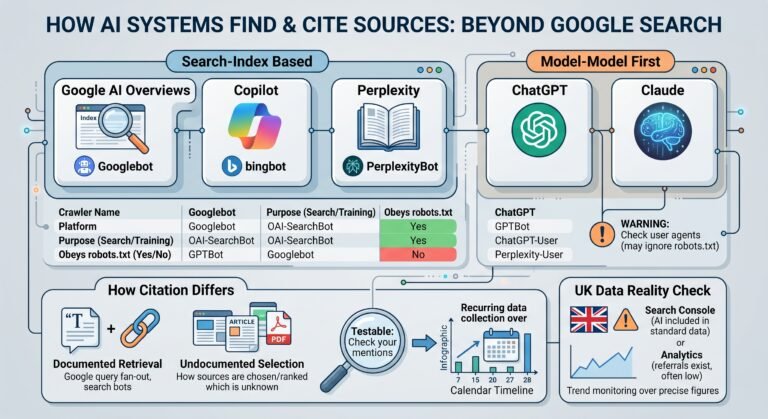
Whether they’ve looked at your robots.txt before quoting. Blocking OAI-SearchBot while allowing GPTBot is backwards, and plenty of sites have it that way. A supplier who checked this before writing a proposal has actually looked at your site.
Whether the reporting shows method as well as results. Screenshots of an assistant naming you prove very little, because answers vary between runs. A table of questions, dates and outcomes proves something.
Whether they’ll say what they won’t do. Suppliers who describe the limits of their own work are, in my experience, the ones whose work holds up.
What I’d do
If you’re holding a proposal now, read the deliverables against Google’s AI optimization guide. Ten minutes, and it tells you how current the document is.
Then ask the five questions above and write down the answers. The answers matter less than whether they’re specific.
Then decide what you’re actually buying: a baseline and diagnosis, or ongoing work. Most small businesses I speak to should buy the first before committing to the second, and I’d say that even when it’s me they’re speaking to.
If it’s useful, AI search visibility describes how I do this, and the acronym question is covered in GEO, AEO, AIO and LLMO.

FAQ
How much should AI search services cost a small business?
There isn’t a sensible standard price, because the cost depends on how many questions matter, how many platforms are worth tracking, the state of the site and what needs writing afterwards. Judge the scope first: a one-off baseline, ongoing work, or full depth. Then ask what the number buys.
What should I ask an agency about AI search?
What exactly will be done in plain English, which platforms and which surface, how success will be measured, what the starting baseline is, and how much of the work is already in your SEO scope. Specific answers matter more than impressive ones.
Can anyone guarantee AI Overview visibility?
No. Google states there are no additional requirements or special optimisations for appearing in AI Overviews or AI Mode, and no supplier controls the ranking systems behind them. A written guarantee of inclusion is a reason to stop the conversation.
Is GEO worth paying extra for?
Only where the proposal names work that isn’t already in your SEO scope, and says how it will be measured. Assistant testing, baselining and source analysis are genuinely additional. Clear answer passages and sound page structure are editorial standards you should be getting anyway.
How do I know if a proposal is out of date?
Check it against Google’s AI optimization guide, updated 10 July 2026. llms.txt files, content chunking, AI-specific markup and LSI keywords are all addressed there, and not favourably. If the document still calls the feature SGE, it predates May 2024.
Sources and method
- Top ways to ensure your content performs well in Google’s AI experiences on Search, Google Search Central, last updated 10 July 2026, accessed 24 September 2026. Google’s position on AI text files, content chunking, writing style for generative AI, and inauthentic mentions.
- AI features and your website, Google Search Central, last updated 10 December 2025, accessed 24 September 2026. No additional requirements or special schema for AI Overviews and AI Mode, the statement that the two may use different models and techniques, and AI feature links being reported within normal Search Console data.
- Overview of OpenAI crawlers, OpenAI, accessed 24 September 2026. The distinction between
OAI-SearchBotfor ChatGPT search features andGPTBotfor model training. - AI Overviews, Wikipedia, accessed 24 September 2026. Secondary source for the May 2024 rename from SGE to AI Overviews.