If you’re a stockist rather than a brand, you’ve got a version of the same problem every other stockist has. The supplier sends a product feed, the description comes with it, and now that exact paragraph sits on your site and on forty others.
Nobody is going to prefer your page on the strength of copy you didn’t write and don’t own. This is about what to do instead, and more usefully, which products to bother with.
It isn’t a penalty, it’s an absence
Worth clearing up first, because the advice out there is confused on this.
Google doesn’t penalise you for running the manufacturer’s description. What happens is more ordinary: there’s nothing on your page that isn’t on everyone else’s, so there’s no reason to rank you above a larger competitor with the same words.
The consequence isn’t punishment. It’s that you compete purely on domain strength, which is a competition a small store loses.
Don’t rewrite everything
This is where the advice usually goes wrong, and where a lot of money gets wasted. A catalogue of 3,000 products isn’t a rewriting project, it’s a budget you’ll never recover.
Sort your products by revenue and look at the top of that list. On the stores I look at, a small number of products usually carry a disproportionate share of the money, and those are the ones worth hand-writing first.
Then look at Search Console for products that get impressions but almost no clicks. Those are being shown and passed over, which is a page problem you can fix rather than a visibility problem you have to earn.
Everything below that line can keep the supplier copy for now. It isn’t ideal. It’s also not what’s costing you.
What to add that the manufacturer won’t
The supplier writes for every retailer at once, which means they write generically and they never mention the things that actually come up.
What it fits and what it doesn’t. Compatibility, sizing against other brands, whether it works with the thing most of your customers already own.
Who it suits and who it doesn’t. Being straight that a product is overkill for occasional use earns more trust than pushing everyone up the range.
The questions you get asked. Your inbox and your phone are full of them. Whatever people ask before buying should be answered on the page they buy from.
Why things come back. Returns data is the most underused content brief in ecommerce. If a product gets returned because people order the wrong size, say so on the page, plainly. It costs you a few sales and saves you more in returns.
Photographs and detail the supplier didn’t provide. Your own images of the product in use, scale shots, what’s in the box.
The bit about AI answers
Assistants and AI Overviews answer a lot of the pre-purchase questions now, and they draw on whatever’s written down clearly.
If your product page says exactly what every other stockist says, there’s nothing to draw on that would name you specifically. If it carries the compatibility answer or the sizing guidance nobody else bothered with, there’s at least something. I wouldn’t promise it earns you a mention, but it’s the only version of this work that could.
How to check what’s currently said about your products is covered in is AI search taking your store’s traffic.
A note on AI writing the descriptions
You can generate descriptions at scale. Plenty of stores are doing it and the tooling is decent now.
The catch is that generated copy based on the manufacturer’s copy reproduces the same problem in different words. It’s not duplicate any more, but it still contains nothing that isn’t already available, which was the actual problem.
Where it does work is as a first draft for something you have real input into: your returns data, your compatibility notes, your answers to the common questions. Generation is fine. Generation with nothing to say isn’t.
Where I’d start on a real store
Twenty products. Top of the revenue list, plus anything with impressions and no clicks.
Write those properly, leave the rest, give it a quarter, and compare those twenty against a control group of similar products you didn’t touch. That tells you whether it’s worth doing the next fifty, on your store rather than in principle.
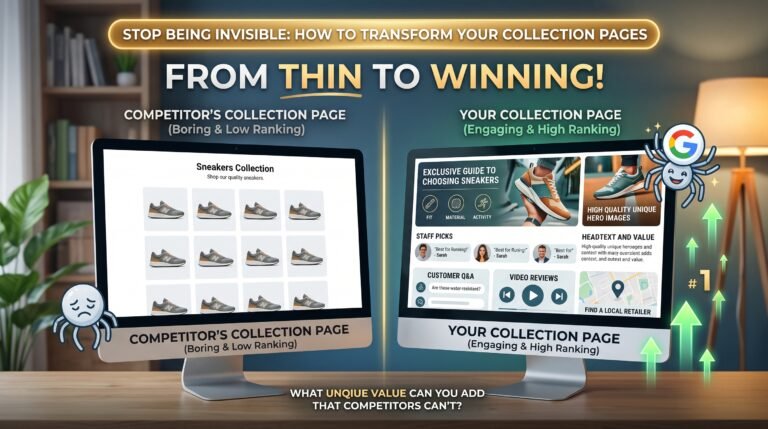
The ecommerce page covers how I work with stores, and there’s more on category pages in why your collection pages don’t rank.
Questions people ask
Will Google penalise duplicate product descriptions?
No. There’s no penalty for using supplier copy. What happens is that your page offers nothing another stockist’s doesn’t, so there’s no reason to rank you higher, and the bigger site usually wins by default.
Should I rewrite my whole catalogue?
Almost never. Start with the products that make you money and the ones getting impressions without clicks. A full rewrite is expensive, slow, and most of it will be on products that would never have earned it back.
Can I use AI to write product descriptions?
As a drafting tool, yes, provided you’re feeding it something real: your returns data, compatibility notes and the questions customers actually ask. Generating variations of the manufacturer’s copy solves the wording and not the problem.
What about the supplier’s images?
Same principle. Your own photographs, particularly scale and in-use shots, give people something they can’t get on the other five sites selling the same item.
How do I know if it worked?
Change a set of products, leave a comparable set alone, and compare them after a quarter in Search Console. That’s a better answer than any general claim about rewriting, because it’s measured on your catalogue.