Organic traffic usually drops for one of a handful of reasons: fewer people searching, a fault on the site, Google showing your pages less, a changed results page, or a change you made yourself. Each one leaves a different pattern in Search Console, so you can test them in order and rule most of them out before spending anything on a fix.
A message I see often runs like this. Enquiries from Google have slowed, the Search Console chart points down, and three people have each suggested something different: a redesign, a monthly SEO package, more blog posts. None of them has said what changed. The better first step is to work out what happened, and only then decide what to pay for.
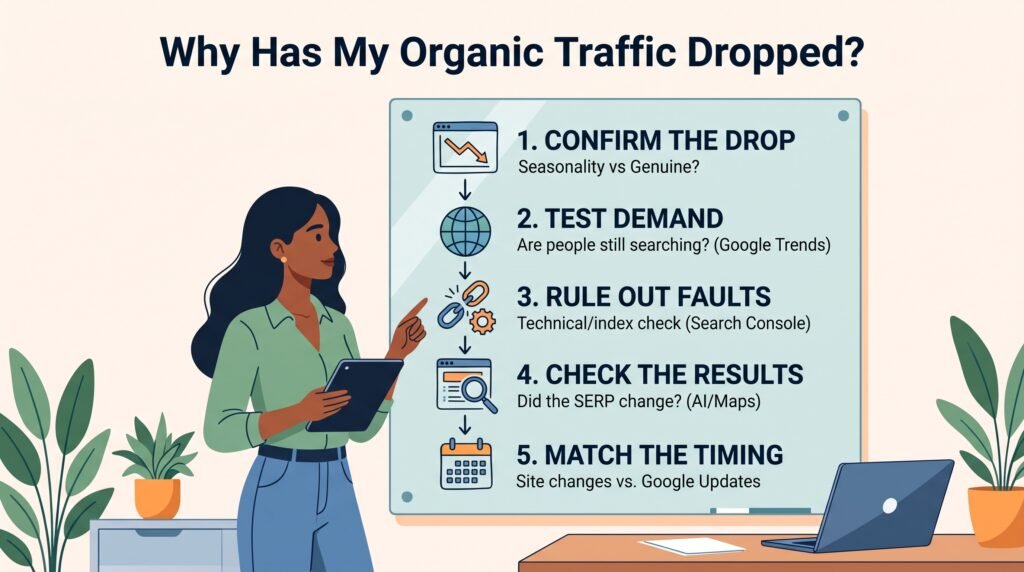
This is the sequence I follow. Most of it you can do yourself with a free Search Console account, and I’ve said where the checks stop being conclusive.
How do I know the drop is real?
Open the Performance report in Search Console, set the date range to the last 16 months and compare it with the same period a year earlier. That separates a genuine fall from seasonality or a one-off dip. Then check the Pages and Queries tabs to see whether the loss sits on a few pages or across the site.
Google’s own guide to debugging drops in Search traffic starts the same way: look at the main chart first and match the pattern to a cause. If clicks and impressions both fell, the cause is probably that the pages are being shown less. If impressions held and clicks fell, it points to what people see when your page does appear.
Two limits matter before you read much into the chart. Search Console only keeps 16 months of data, so if your decline began earlier, the start of it may already be gone. Google also says a drop can sometimes be a reporting or logging issue, so a sudden cliff in one report is worth checking against another source such as Analytics.
Size the fall before anything else. A page that went from 29 clicks a month to 3 has lost 90% of its traffic and about 26 visits. Both numbers are true, and you need both to decide how much the problem matters.
Did people stop searching?
Check Google Trends for the phrases your customers use, over several years. If interest in the topic fell, your traffic fell with it and no page fix will bring it back. If interest held steady or rose while your clicks dropped, the cause sits somewhere else, on your side or in the results themselves.
Trends has limits. It shows a relative index, not search volumes, and small local phrases often don’t have enough data to chart at all. On a recent investigation, the broad phrases for the course I was looking at were steady or rising through 2026, which ruled out falling demand for those terms. The narrower phrases the page actually ranked for were too small to chart, so I couldn’t say the same for them. A keyword tool with monthly volumes would settle that, and I’d use one before telling a client demand wasn’t the issue.
Did something break on the site?
Check indexing, canonicals, redirects, speed and security, because a technical fault can remove pages from Google without anyone noticing. The Page indexing report shows which pages Google has indexed and why others aren’t. The Crawl stats report shows whether Google is having trouble reaching the site. A crawl of your own can find broken links, missing titles and orphaned pages.
Google lists technical problems, security issues and spam actions as separate causes, each with its own report in Search Console (Security issues and Manual actions). It takes a few minutes to check both. If they’re empty, a penalty and a hack are off the table before anyone suggests a rebuild.
I’d also inspect the handful of pages that lost the most traffic one by one with the URL Inspection tool. Look for a stray noindex tag, a canonical pointing at another page, or a redirect added during an edit. On the investigation I mentioned, the seven key pages were all indexed with the right canonical, and a crawl of 54 pages found no broken ones. It meant nobody needed to spend money on technical repairs.
Is Google showing the pages less, or are people clicking less?
Impressions measure how often a page appeared in results, clicks measure how often someone chose it, and average position sits between them. A fall in impressions with steady position means your pages are appearing in fewer places. A fall in clicks with steady impressions means something about the listing or the results page is changing people’s minds.
I’ve written about the second pattern separately in impressions up, clicks down, including how AI Overviews are counted. The first pattern is the one people miss. In the data I looked at, a trailer towing page lost 82% of its impressions year on year, yet for several of its searches the average position had held or improved. That looks like fewer places where the page was shown, though Search Console can’t tell me which places disappeared.
Be careful with average position as a headline figure. It averages every search you appeared for, so appearing for lots of new low-ranking searches drags it down even when nothing has gone wrong. Check position query by query before you decide rankings have fallen.
Has the results page changed?
Search the queries that lost traffic yourself, from the area your customers are in, and note what now sits above your listing. AI summaries, map results, adverts, videos and directories can all push a normal listing down the page. Search Console won’t show you any of this, because it only records your own listing.
One check on one device is a snapshot, not a measurement. Results differ by person, location and day, and AI summaries change from one search to the next. What a manual check can do is suggest where to look. In the local search I checked, an AI summary and a map pack sat above the standard listings, and the business was missing from the map results for trailer searches while competitors appeared. That gave a lead on what to fix, but it didn’t prove those changes had cost clicks.
If you do your own check, write down what you saw and when, then repeat it weekly for a few searches.
Does the timing line up with an update or an edit?
Match the date of the drop against Google’s ranking updates and, more usefully, against every change made to your own site. Google keeps a history of ranking updates on its Search status page, and its guidance says to check it. A matching date is a lead rather than a cause, because plenty of unrelated things change in the same weeks.
In practice, the second half of that is where investigations stall. Nobody has a record of when the theme was updated, a plugin installed, a page rewritten or a batch of location pages added. If you don’t know the date of your own edits, you can’t separate an update’s effect from your own. In WordPress, a page’s Revisions screen shows when each saved version was made, which is a start if nothing else was kept.
I treat update timing as a possibility to be tested. On the driver training investigation, one sharp fall coincided with a Google spam update and hit every service page on the site. That made an update plausible. It didn’t make it proven, and I said so in the report. A later slide affected only one group of pages and lined up with no single update, which pointed away from a site-wide cause.
Can I tie the drop to enquiries?
Only if something was recording enquiries in the first place. A drop in Search Console visibility is a drop in opportunity. Whether it’s a drop in bookings depends on phone calls, form sends and map-listing activity, and many small business sites record none of them.
This was the biggest gap on the driver training investigation. Analytics had recorded no visits for almost two years, no phone tap or form send had ever been logged, and none of the course pages offered a tap-to-call button or a form. So the visibility loss was proven, and the effect on bookings couldn’t be measured either way. I described that as an opportunity cost, not proven lost revenue: the business may have held its bookings and still got fewer enquiries than stronger visibility would have brought.
If that sounds familiar, enquiry tracking comes before any other fix. Without it, you can’t tell later whether the changes worked. The Google Business Profile also keeps a performance history, though only for six months, so save it monthly.
Investigation, redesign or ongoing SEO: which one fits?
An investigation fits when you don’t yet know why traffic fell, a redesign fits when the site itself is the problem, and ongoing SEO fits when the cause is known and the work is continuous. The risk is buying the second or third before you’ve done the first, and rebuilding a site that had nothing wrong with it.
A redesign won’t fix a decline that came from somewhere else. A new design on a site with a weak map listing and no enquiry tracking still has both problems. Ongoing SEO can have the opposite problem: monthly activity with no diagnosis behind it.
An investigation produces a report, not a retainer. It sets out what happened, what’s likely, what’s ruled out and what can’t be proven from the data available, then ranks the fixes by what to do first. If you’d like a worked example, the driver training investigation case study shows the report and the actions it recommended. The service is described on the traffic decline investigation page.
What I learned from the last one I ran
On the driver training investigation, the most useful result was the list of what it ruled out. Four ordinary suspects were set aside: falling demand, a technical fault, slow pages and a site-wide penalty. That left the work focused on the results page, the map listing and the course pages, instead of a rebuild.
The second thing was how much depended on records that didn’t exist. No Analytics history, no enquiry log, no list of site changes and six months of profile data meant several questions could only be answered going forward. I’d rather say that plainly in a report than fill the gap with a confident guess.
The third was proportion. The percentage falls were dramatic, but the click numbers behind them were small, and the report said so next to each figure. A business owner deciding where to spend a month needs the size of the problem as well as the direction.
If someone quotes you for a fix, what should you ask?
Ask what they think caused the drop, which data shows it and what would change their mind. A useful answer names a specific cause, points to evidence you can look at yourself, and says what remains unproven. If the answer is the name of a service, the fix has come before the diagnosis.
What do you think caused the drop? A redesign suits a different cause from a content programme or a technical clean-up. If the supplier can’t say which cause theirs addresses, ask why it should be the first thing you buy.
Which data shows it? You should be able to see the same Search Console pages and queries they’re describing. If the explanation can’t be checked against anything you can open, treat it as a guess.
How will we know if it worked? Agree the searches, pages and enquiries to watch before work starts, and how long you’ll give it. Google says there’s no guarantee that changes will have a noticeable impact, so a promise of recovery needs evidence behind it.
Is any of this already in what I’m paying for? Titles, internal links and a clear answer near the top of a page are ordinary SEO work. If you’re paying extra, you should be able to point to what’s extra.
What I’d do first
Start with the free checks, in this order: confirm the drop, test demand, rule out faults, look at the live results and record your own changes. None of them needs a consultant, and they’ll show whether you need one. Three actions come before everything else.
- Export the last 16 months from Search Console and save it, because Google won’t keep it for you.
- Set up enquiry tracking for phone taps and form sends, then start a simple log of how each enquiry arrived.
- Write down every change made to the site in the last 12 months, with dates, even if you have to reconstruct them from revision histories.
What can wait: a redesign, new content, and any work on pages that haven’t lost traffic. If you’ve done those checks and the cause still isn’t clear, a traffic decline investigation takes the same steps further with full data access and a prioritised plan. You can also ask for a free assessment first.
If the drop followed a specific event, there are separate guides: after a redesign, after a Google update, and when enquiries fall but traffic holds.
FAQ
Why has my organic traffic suddenly dropped?
A sudden drop most often comes from a technical fault, a security or spam issue, a site move, or a Google update. Check Search Console’s Page indexing, Security issues and Manual actions reports first, then the date against Google’s list of ranking updates. Rule out a reporting glitch by comparing with Analytics.
How long does it take to recover organic traffic?
Nobody can give a reliable timescale, and Google says there’s no guarantee that changes will have a noticeable impact. For a large drop after an update, Google suggests waiting a few weeks before re-analysing. Recovery depends on the cause, and some causes, such as an AI summary answering the search, may not reverse.
Is a Google algorithm update the reason my traffic dropped?
It may be, but timing alone doesn’t prove it. Compare the date of your drop with Google’s ranking update history, then see whether every kind of page fell or only some. A drop confined to one group of pages points more towards your own changes or the results page than towards an update.
Can I find out why my traffic dropped without an SEO consultant?
Often you can narrow it down. Search Console, Google Trends and a manual look at the live results will rule out several causes for free. A consultant becomes useful when the checks conflict, when the history is missing, or when you need the findings ranked by what to do first.
Does a drop in organic traffic mean I’ve lost sales?
Not necessarily. Traffic is a measure of opportunity, and sales depend on whether visitors enquire and whether you can track it. A business can lose visibility and keep its bookings, or lose bookings without it showing in the traffic. Enquiry tracking is the only way to connect the two.
Sources
- Debugging drops in Google Search traffic, Google Search Central, last updated 10 December 2025, accessed 20 October 2026. Supports: the main causes of traffic drops, the Search Console reports to check, the 16-month date range, comparing periods, using Google Trends, checking Google’s ranking updates list, the possibility of a reporting or logging issue and the absence of any guarantee of impact.
- What are impressions, position, and clicks?, Search Console Help, accessed 20 October 2026. Supports: how impressions, clicks and position are counted, including in AI Overviews and AI Mode.
- AI features and your website, Google Search Central, last updated 10 December 2025, accessed 20 October 2026. Supports: AI features are included in overall Search Console traffic, reported under the Web search type.
- Paul Myers, traffic investigation for a local driver training business, 2026 (client details withheld). Search Console, Business Profile, crawl and live-results checks. Supports: the examples of page and impression changes, ruled-out causes and tracking gaps.