Schema markup is in an odd position. Google has removed several of the rich results it used to produce, and has stated plainly that structured data isn’t required for AI Overviews or AI Mode. Meanwhile a lot of AI visibility proposals still list “schema implementation” as a deliverable.
Both of those things can be true without the work being pointless, but the reasons for doing it have changed, and some of the reasons people give for it are now wrong. This is my attempt at an honest current position. The shorter version, focused on which types produce results, is in which schema types still matter.
What Google actually says about structured data and AI features
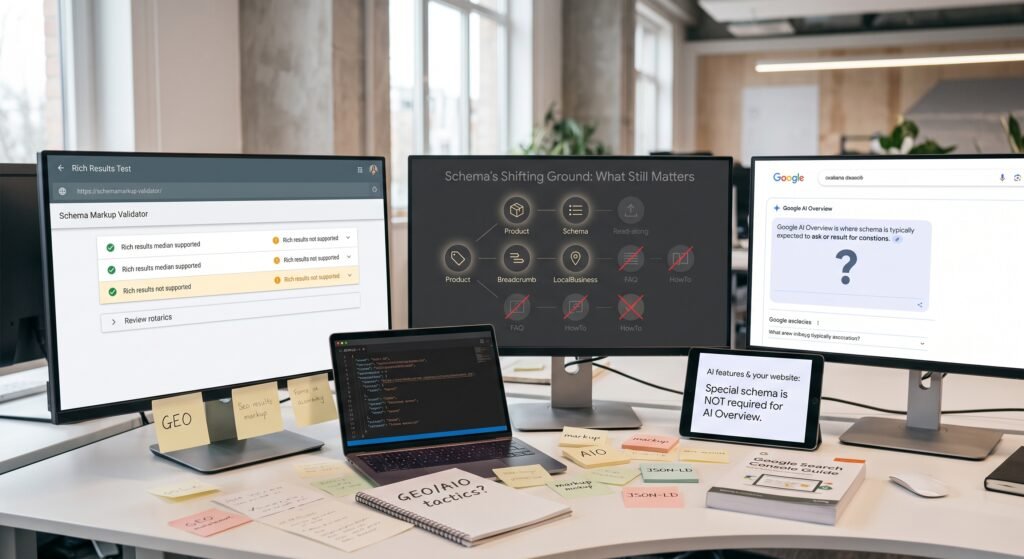
The relevant document is AI features and your website, last updated 10 December 2025. It’s explicit: you don’t need to create new machine-readable files, AI text files or markup to appear in AI Overviews or AI Mode, and there’s “no special schema.org structured data that you need to add”.
That’s as clear as Google gets, and it disposes of the most common claim in AI proposals. Schema is not an AI visibility lever, and nobody should be charging for it as one.
It doesn’t say structured data is useless. It says it isn’t a requirement or a special route into AI features. Those are different claims, and the distinction gets lost in both directions: by people selling schema as a GEO tactic, and by people concluding there’s no longer any point.
What structured data still earns
Three things, in descending order of how confident I am about them.
Rich results in ordinary search. This is the documented, observable benefit and it hasn’t gone away for the types Google still supports. Product with price and availability, Review snippets where they’re genuinely third-party, Recipe, Event, Video, Breadcrumb, JobPosting, LocalBusiness. These produce visible changes in search results and you can verify them in the Rich Results Test. If you sell things, Product markup and a Merchant Center feed remain the clearest structured data wins available.
Unambiguous facts about your business. Organization and LocalBusiness markup state your name, address, phone number and hours in a form that doesn’t depend on a machine parsing your footer correctly. Google’s guidance for local visibility in AI responses points at Google Business Profile rather than schema, so I’d put the profile first. But consistent, machine-readable business details across your site and profile is cheap, and inconsistency is a real problem I find often.
Helping a machine parse a complicated page. This is where I’m least able to point at evidence and most convinced from experience. On pages with a lot of entities, a specification table, a multi-step process, markup makes the structure explicit rather than implied. Whether that helps an AI system specifically, I can’t demonstrate, and I’d flag anyone claiming they can.
What it no longer earns
FAQ rich results ended in May 2026. Google stopped showing the expandable questions in search results for most sites. If a proposal offers FAQ schema for the rich result, that result no longer exists.
HowTo rich results went the same way earlier. Google deprecated them, and marking up a how-to page no longer produces the step display it used to.
Review markup on your own testimonials has never been allowed. Google’s guidelines prohibit self-serving review markup, meaning a business marking up reviews it hosts about itself. I still find this on sites and it carries risk for no benefit.
Markup for content that isn’t visible on the page breaks Google’s structured data guidelines. That applies to FAQ schema too: if the questions and answers aren’t on the page where a reader can see them, they shouldn’t be in the markup.
So why do I still output FAQ schema?
Because I think there’s a reasonable case, and I want to be straight that it’s a judgement rather than a documented benefit.
The reasoning: AI systems read structured content, a visible question-and-answer section is a clean, self-contained format, and FAQPage markup describes that structure unambiguously. Clearly delimited question-and-answer content is the shape of thing that tends to get quoted.
What I can’t do is prove it helps. There’s no published evidence that FAQPage markup influences AI citation, and Google has said structured data isn’t needed for AI features. So the honest position is: the FAQ section itself is doing the work by answering real questions in a quotable form, and the markup costs almost nothing on top of a section I’d write anyway.
If it turned out tomorrow that the markup contributed nothing, I’d have lost very little. That’s a different argument from claiming it works, and I’d rather make the weaker argument accurately. I’ve got a test running on this on my own site, and I’ll publish whatever it shows, including if it shows nothing.
Where the effort actually goes
If you have a fixed number of hours, here’s how I’d spend them.
Get Organization, LocalBusiness where relevant, and Breadcrumb right across the site, once, in a template. This is structural work that doesn’t need revisiting and it removes ambiguity about who you are.
If you sell products, do Product markup properly, with price and availability kept accurate. Inaccurate Product markup is worse than none, because it can cost you eligibility.
Then stop, and put the remaining hours into the page content. Google’s AI optimization guide points at clear heading structure, first-hand perspective, content that isn’t recycled, and pages that are indexed and snippet-eligible. None of that is markup.
The failure mode I see most often is a site with immaculate schema and thin content, usually because schema is legible as a deliverable and content quality isn’t.
A note on validation
Whatever you implement, validate it. Google’s Rich Results Test shows what’s eligible for a rich result, and the Schema Markup Validator checks the markup itself. They answer different questions and it’s worth running both.
Check again after any template change. The most common way schema breaks is a developer editing a template without realising the JSON-LD was generated from a field they changed. If your CMS builds schema from page fields, that’s a good thing, and it means the markup needs re-testing whenever the fields move.
One specific trap, because it’s caught me: if your JSON-LD is assembled from CMS content, a stray newline or an unescaped quote in an editor field will break the whole block silently. Validate the parsed output, not the template.
What I’d do
Run the Rich Results Test on one page of each type on your site. It takes ten minutes and tells you whether what you have is eligible for anything.
Check whether you’re still carrying markup for results that no longer exist. FAQ and HowTo are the common ones. There’s no harm in keeping FAQ markup if the questions are visible, but don’t count it as a rich result strategy.
Check for self-serving review markup and remove it if it’s there.
Then look at the gap between how good your markup is and how good your content is. If the markup is the stronger of the two, the next hours belong in the content.
This is part of what I do in a technical audit, and there’s more at technical SEO audits. For the AI side of the question, GEO, AEO, AIO and LLMO covers what is and isn’t a real lever.
FAQ
Does schema markup help with AI Overviews?
Google states there’s no special schema.org structured data needed to appear in AI Overviews or AI Mode. Structured data isn’t a route into AI features, and it shouldn’t be sold as one. It still earns rich results in ordinary search for the types Google supports.
Is FAQ schema still worth adding in 2026?
FAQ rich results ended in May 2026, so it no longer produces the expandable questions in search. I still output it, on the reasoning that clearly structured question-and-answer content is quotable and the markup costs little on top of a section worth writing anyway. That’s a judgement, not a documented benefit.
Which schema types still produce a result?
Product, Review where genuinely third-party, Recipe, Event, Video, Breadcrumb, JobPosting and LocalBusiness are the types still producing visible changes in search results. Run the Rich Results Test on your own pages to confirm eligibility, because support changes.
Can I mark up my own customer reviews?
No. Google’s guidelines prohibit self-serving review markup, meaning a business marking up reviews about itself that it hosts. It carries risk and produces no benefit. Third-party review platforms are a different matter and have their own integrations.
Should structured data be in an AI search proposal?
Not as an AI visibility deliverable, because Google has said it isn’t required for AI features. As part of technical SEO for rich results and unambiguous business information, it’s reasonable work. The distinction matters because one is chargeable for a reason and the other isn’t.
Sources and method
- AI features and your website, Google Search Central, last updated 10 December 2025, accessed 24 September 2026. The statement that no special schema.org structured data is needed for AI Overviews or AI Mode, and no machine-readable files or markup are required.
- Top ways to ensure your content performs well in Google’s AI experiences on Search, Google Search Central, last updated 10 July 2026, accessed 24 September 2026. Google’s list of what does help, including heading structure, first-hand perspective and indexability, and the guidance pointing local visibility at Google Business Profile.
- Using generative AI content, Google Search Central, last updated 10 December 2025, accessed 24 September 2026. The requirement that quality standards apply to structured data as well as body content.
On what isn’t sourced. The claim that markup helps a machine parse a complicated page is my experience, not a documented finding, and it’s labelled that way in the text. The reasoning for continuing to output FAQPage markup is explicitly a judgement, and the test running on my own site will be published whatever it shows.