A lot of local businesses around Liverpool are being sold AI search services at the moment. Before anyone spends money on that, there’s a check worth doing, and it takes about five minutes.
Look at the searches that actually bring you enquiries. Not industry questions, the searches a customer types when they’re ready to call someone. Then see whether Google shows an AI answer on them at all.
I did that on 24 September 2026 for a handful of North West commercial searches. The results were consistent enough to be worth writing up.
What I found
Four searches, run live through Google with the location set to Liverpool. Three were local commercial searches of the kind that produce enquiries. One was an informational question from the same sector as the first.
| Search | Intent | AI Overview | Map pack |
|---|---|---|---|
| accountants liverpool | Local commercial | No | 4 places |
| emergency plumber wirral | Local commercial | No | 3 places |
| commercial cleaning services liverpool | Local commercial | No | None shown |
| how much do accountants charge for a limited company uk | Informational | Yes | None |
None of the three local commercial searches produced an AI Overview. All three produced the ordinary local result set, and two showed a map pack with paid ads above it.
The informational search did produce an AI Overview, and no map pack.
Four searches on one day is a spot check and not a study, and I’d expect this to change. But the boundary it points at isn’t the one most people assume, and it’s worth setting out.
The boundary is intent, not industry
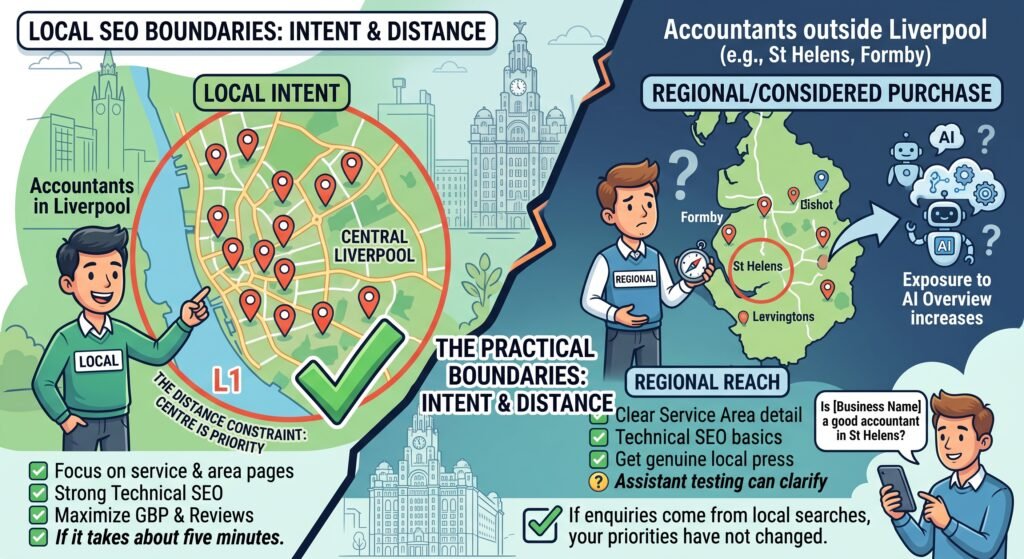
Notice that two of those searches are in the same sector. “Accountants Liverpool” gets a map pack and no AI answer. “How much do accountants charge for a limited company” gets an AI answer and no map pack.
So the question isn’t whether accountancy is affected by AI search. It’s which of your searches are.
That matches the published research. Work analysing AI Overview appearance, published in August 2026 from a US panel, found overviews more likely on longer queries, queries starting with question words, and queries containing both nouns and verbs. “Accountants Liverpool” is none of those. “How much do accountants charge for a limited company” is all three.
It also matches Google’s own architecture. A search with local intent triggers the local results system, which is a different thing from the AI features, and Google’s guidance for local visibility in AI responses points at Google Business Profile rather than at anything on your website.
What this means if you’re a local business
Three positions, and they follow directly from the above.
If your enquiries come from local commercial searches, your priorities have not changed. Google Business Profile completeness and accuracy, reviews, local relevance on your service and area pages, and the ordinary technical foundations. That’s the same list it was three years ago, and I’d be cautious of anyone selling you an AI package that displaces it.
If your enquiries start with a research phase, you are more exposed. A customer who reads two or three guides before calling anyone is now more likely to get the first of those from an AI answer. That doesn’t remove you from the process, but the top of it narrows. Professional services and considered purchases feel this most.
If you’re outside the city centre, the constraint is still distance. Google’s local ranking has long worked on relevance, distance and prominence. Being in Formby or St Helens instead of L1 is a real constraint on centre-of-city searches, and no amount of content work changes your address. The honest strategy there is to compete properly on your actual catchment and on the searches where distance matters less.
Where AI genuinely does change local
I don’t want to talk anyone out of caring about this, because there is a real shift and it isn’t visible in the SERP checks above.
When someone asks an assistant “who’s a good accountant in Liverpool”, they get a short list. Not ten blue links and a map, a handful of names. Being absent from that list is a different kind of problem from ranking eleventh, because there’s no second page to be on.
I can’t tell you how many of your customers do that instead of searching Google, and nobody can, because the platforms don’t publish it. What I can tell you is that the check is free. Ask ChatGPT and Perplexity the questions your customers would ask, and see what comes back. If you’re named and the description is right, good. If a competitor two miles away is named and you aren’t, that’s worth knowing.
The other thing worth knowing is what those assistants draw on for local recommendations. Observably, directories, review sites and local press come up a lot. I’d treat that as an observation from testing rather than a documented mechanism, because none of the platforms publishes its source selection.
The practical list, in order
For a local business in the North West right now, this is how I’d sequence it.
Google Business Profile first, and properly. Categories, service areas, hours, photos, and a steady flow of genuine reviews. It remains the largest single factor in local visibility and it’s free.
Then your service and area pages, written as real pages. Genuine detail about the areas you cover and the work you do there, not a list of postcodes in the footer. This is the bit most small sites get wrong, and it’s also what gives an assistant something specific to draw on.
Then the technical foundations. Crawlable, indexable, fast enough, consistent business details everywhere. While you’re there, check your robots.txt isn’t blocking OAI-SearchBot or PerplexityBot, which I find more often than you’d think.
Then, and only then, the assistant testing. Monthly, recorded, using the questions your customers actually ask.
If you want the detail on that last part, AI search in the UK covers how each platform finds sources, and there’s a local page at SEO in Liverpool.
What I’d do this week
Run your top five enquiry-generating searches yourself, in an incognito window, and look at what’s actually on the page. Google personalises results even in incognito, so it’s indicative and not definitive, but it beats assuming.
If there’s no AI Overview on them, you’ve just saved yourself a budget decision.
If there is one, note whether it’s answering the whole question or pointing at options. Those are different problems.
Either way, ask ChatGPT and Perplexity the same questions, and write down what they say about you. That’s your baseline, and almost nobody has one.
This is the work I do with local clients, and there’s more at AI search visibility.
FAQ
Do AI Overviews appear on local searches?
In my spot check of three North West local commercial searches on 24 September 2026, none produced an AI Overview. All three returned the ordinary local results, two with a map pack. That’s four searches on one day and not a study, but it matches research finding that overviews concentrate on longer, question-shaped queries.
Has local SEO changed because of AI search?
For businesses whose enquiries come from local commercial searches, the priorities look much the same: Google Business Profile, reviews, genuine service and area pages, and sound technical foundations. The change is bigger for businesses whose customers research before choosing.
Should a Liverpool business pay for AI search services?
Check first. Run your enquiry-generating searches and see whether an AI answer appears on them. If it doesn’t, that’s a budget decision made for free. Separately, test what ChatGPT and Perplexity say about your business, because recommendation visibility is real even where AI Overviews are absent.
Does being outside Liverpool city centre still matter?
Yes. Google’s local ranking works on relevance, distance and prominence, and distance is a real constraint on centre-of-city searches that content cannot overcome. The workable approach is competing properly across your actual catchment and on searches where distance matters less.
What do AI assistants use for local recommendations?
None of the platforms publishes its source selection, so nobody can answer this definitively. In my own testing, directories, review sites and local press appear often. Treat that as an observation from testing and not a documented mechanism.
Sources and method
- Own spot check: four live Google searches captured 24 September 2026 through SerpApi, engine
google,gl=uk,hl=en, location Liverpool, England, United Kingdom. Recorded AI Overview presence, map pack places and result blocks. Three local commercial searches returned no AI Overview; one informational search in the same sector did. Raw captures and method are in the project research folder. - Investigating Click Behaviors On Google Search Result Pages That Produce an AI Overview, Chapekis, Lieb, Shah and Smith, arXiv:2608.04831, submitted 5 August 2026, accessed 24 September 2026. The finding that longer queries, question-word queries and queries containing both nouns and verbs are more likely to produce an AI Overview. US panel of 900 adults, March 2025 data.
- Top ways to ensure your content performs well in Google’s AI experiences on Search, Google Search Central, last updated 10 July 2026, accessed 24 September 2026. Google’s guidance pointing local visibility in AI responses at Google Business Profile.
- Overview of OpenAI crawlers, OpenAI, accessed 24 September 2026, and PerplexityBot and Perplexity-User, Perplexity, accessed 24 September 2026. The search crawler tokens referenced in the robots.txt check.
On the limits. Four searches on one day, from one location, is a spot check. Google personalises results by location and other signals, so your own results may differ, which is why the article tells you to run your own.