Somebody running a plumbing firm, a cleaning company or a letting agency often has a page in mind: the service plus the town they work in. It’s a sensible instinct. Before anyone writes it, look at what that search returns, because the answer isn’t always a page of businesses like yours.
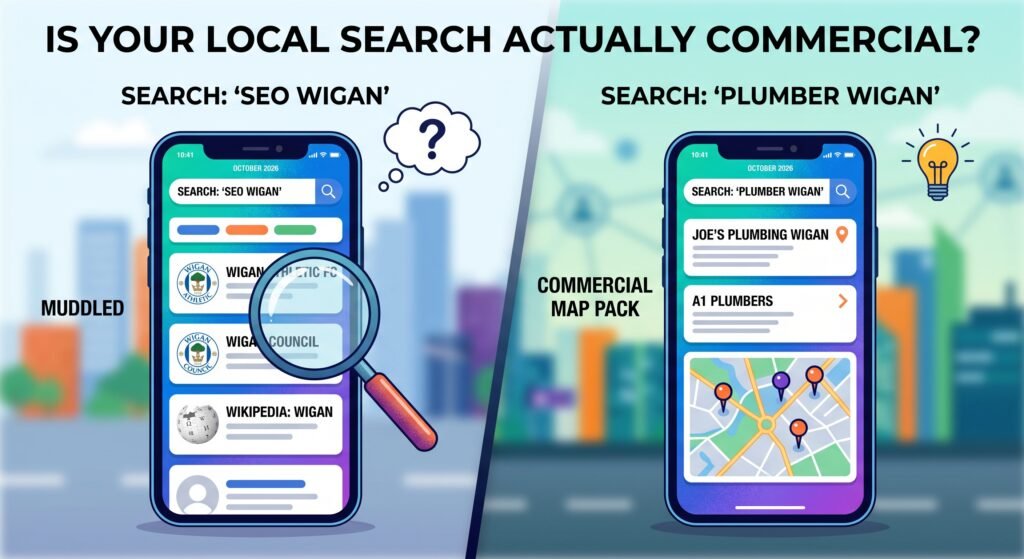
I ran that check for my own service in four towns near me and the results were less tidy than I expected. Two of them came back muddled both times. The other two changed between a first check and a second a few days later, which taught me how much weight a single check can bear.
What I searched, and what came back
The search was “seo” plus a town name, once for each of Wigan, Bury, Leigh and Bolton, with the results location set to the town. I ran it at the end of September 2026 using one version of a search results service, then again at the start of October 2026 using a fuller version of the same service. The second time I added a version with “services” after the town name. That is one query per town per check, so these are spot checks and nothing more.
| Town | First check | Second check | With “services” added |
|---|---|---|---|
| Wigan | The town itself: an encyclopedia entry, the football club, the council | SEO agencies, including one with the town name in its web address, and a map listing of three | Agencies again, with a map listing of four |
| Bury | Mostly pages about burying things in search results | Job listings, a forum thread about suppressing results and one Manchester agency | Job listings and forum threads, one agency and a map listing of three |
| Leigh | A run of people called Leigh, as a first name or a surname, and one local news item | Job listings and more people with Leigh in their name | Local and regional agencies, with a map listing of three |
| Bolton | A surname, a social profile and only a few local businesses | Local agencies, one result for a Bolton in Canada and a map listing of three | Agencies again, with a map listing of three |
In Bury the word is a verb, so the search drifts towards burying bad content in results. In Leigh it’s a first name and a surname. Adding “services” cleaned the results up largely in Leigh and only partly in Bury, where job listings and forum threads still took most of page one.
What the checks show
In two towns, Bury and Leigh, the plain “seo” plus town search wasn’t a page of local businesses on either check. A town name can also mean a verb, a person, a football club or a council, and the search engine has to guess which you meant.
The Wigan and Bolton results are the ones I’d be more careful with. The first check returned the town and its institutions in Wigan, and a surname in Bolton. The second returned agencies and a local map listing in both. I can’t tell you why. The checks used different versions of the results service, three days apart, and I can’t separate the effect of that from the effect of timing or from how the location is applied. All three are plausible, and I haven’t tested which it was.
If I’d stopped at the first check, I’d have written off Wigan and Bolton. If I’d run only the second, I’d have missed that Bury and Leigh needed more than the town name. One search, run once, can mislead in either direction.
“SEO Wigan” is also my own search, the one somebody types when they want my service, so it tells you nothing about what your customers do. A homeowner looking for a plumber types the trade, and a trade word may well pin down the meaning in a way a bare town name doesn’t, though I haven’t checked those searches. The check is about whether the search you intend to target behaves.
How I’d test your own search
Pick the search you’re thinking of building a page for and look at it the way a customer would. Use a phone, away from your own wifi, signed out of Google if you can, and ideally from somewhere in the town. Results can differ with location and device, which is part of why a check on your own laptop can be misleading.
Then look at what’s on page one. Are most of the results businesses like yours, or directories, job boards, forums and pages about something else? Is there a map listing, and who’s in it? If the town name has another meaning, how much of the page is about that?
Run it again on another day, and try the version with the service word added, or with your trade phrased the way a customer would say it. If the town name on its own gives a muddled page and the service plus town gives a clean one, that second search is the one to plan around. If the map listing is where the businesses are, the Google Business Profile may matter more than a page for the town. Google names relevance, distance and prominence as the main local ranking factors, and a well-kept profile speaks to relevance and prominence directly.
If page one is thin or held by results from other places, that’s worth knowing too. It can mean a well-written page has room, though I wouldn’t assume that without checking how many people are actually searching and whether they turn into enquiries.
Pages for every nearby town
I wouldn’t turn a muddled town name into a reason to publish a page for every nearby town with the name swapped. Google’s spam policies describe doorway pages as pages made to rank for similar searches that lead people to something less useful than the destination, and a run of near-identical town pages fits that description. A page for a place is worth writing when you have something true to say about working there.
If you want a second opinion on which searches deserve a page, that’s part of what I do with keyword research, and the locations section shows how I’ve approached a few of the towns near me.
FAQ
Does the town name matter in a local search?
It matters, but it can also confuse. Where a town name is also a verb, a first name or a surname, the results can include pages about those meanings. Searching the service together with the town usually gives the search engine more to work with, though I’d check it for your own area instead of assuming.
Should I build a page for every town I cover?
Not by default. A page for each place needs something true to say about it, such as how far you’ll travel or the kind of work you already do there. Near-identical pages with a different place name are the pattern Google’s guidance on doorway pages describes.
How do I check what my customers see?
Search from a phone, away from your own wifi, ideally signed out and from the town itself, using the words a customer would use for your service. Repeat it on another day. Results can vary with location and device, so a single check on your own computer shouldn’t settle anything.
Why would the same search give different results on different days?
I can’t give a single reason. Search results change, location and device affect them, and the tool that fetches them may not behave the same way each time. In my own checks I couldn’t separate those effects, which is why I’d repeat any check before acting on it.
Is the map listing separate from the ordinary results?
Yes, they’re different parts of the page and are decided differently. For many local searches the map listing sits above the ordinary results, so I’d look at who appears there and how many reviews they have before deciding where to spend effort.
Sources and method
- SerpApi results for google.co.uk, UK language settings, query “seo [town]” for Wigan, Bury, Leigh and Bolton, location set to the town, using SerpApi’s Google Light engine. Checked 28 September 2026.
- SerpApi results for google.co.uk, UK language settings, queries “seo [town]” and “seo services [town]” for the same four towns, location set to the town, using SerpApi’s standard Google engine. Checked 1 October 2026.
- One query per town and engine, so these are illustrative spot checks. The location is a place label sent to SerpApi, and I can’t confirm exactly how it was applied to each town.
- How Google decides local search rankings, Google Business Profile Help.
- Spam policies for Google web search, Google Search Central, for the description of doorway pages.