If you run a student letting agency, the timing of your SEO work matters almost as much as the work itself. A guide published when students are already booking viewings might still be useful, but it has a much harder job than a page that was ready months earlier.
That’s because student lettings don’t behave like the general rental market. Groups tend to form, search, view and sign within a relatively short window. The window differs from one university city to another, so I wouldn’t put a single date on it for every agency. But you can usually find yours in the enquiry and tenancy data you already have. Once you do, it should shape the content plan.
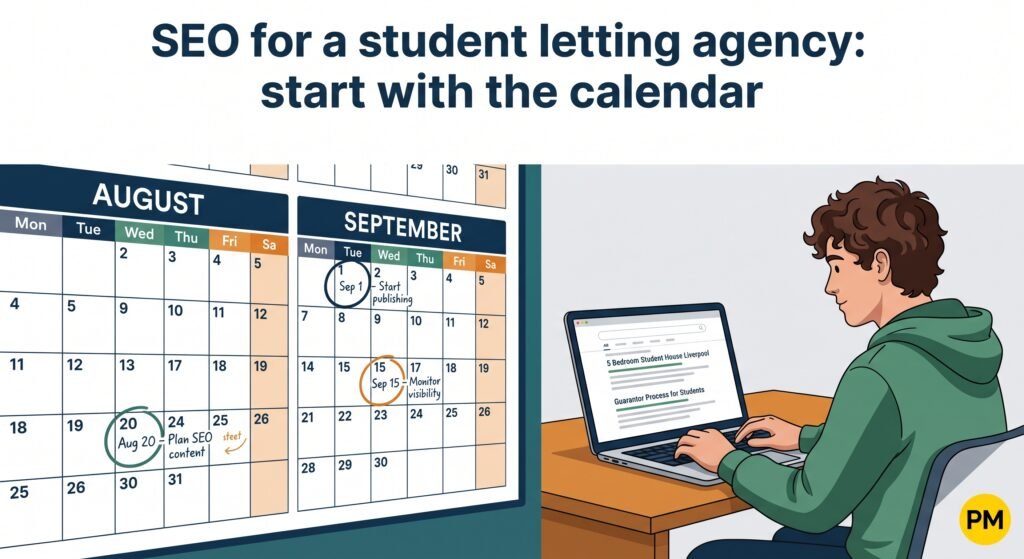
Find your season before planning the work
Start with the dates students actually began enquiring last year, when viewings picked up and when most houses were let. Don’t assume the busy period begins when term starts. In some markets students are looking well ahead of the next academic year, and the pattern may have shifted since your last campaign.
Then work backwards. The pages you want students to find during that window need to be live, accessible to Google and useful before demand peaks. Google can discover and index a new page quickly, but there is no guaranteed period after which it will rank. A page published in the middle of the rush also has less time to earn links, get included in your internal navigation and show you whether it answers the searches you hoped for.
That makes the quieter months a good time to do the work: review the existing pages, update area information, answer recurring questions and make sure the site works properly on a phone. It can feel counterintuitive to invest in content when the enquiry form is quiet. For a seasonal business, that is often when you have room to do it well.
When someone asks me how long SEO will take, I’d talk about their next letting window rather than promise a set number of weeks. The useful question is whether the right pages will be ready and gaining visibility when students begin looking.
Search the way a student group searches
Students don’t always begin with “student accommodation” plus a city. They might know which streets their friends lived on last year, how far they’re willing to walk to campus, or that they need a five-bedroom house and nobody wants the tiny room. The group often comes together before the search for a property.
That gives an independent agency several sensible ways to organise the site: clear pages for the areas it actually serves, useful information about travel to particular universities, and listings that make bedroom counts, availability and costs easy to see. I’d check the agency’s own Search Console queries and enquiry emails before deciding which areas or questions deserve a page. Keyword tools can help, but they won’t always show the detail in a local search.
Then there are the questions people ask before they’re ready to view. Are bills included? Is a guarantor required? How much is the deposit and how is it protected? What happens if someone leaves the group? When should they start looking for next year?
Individually, those searches may look small in a keyword report. Collectively, they tell you what is slowing people down. Answering them clearly can help students decide whether to enquire and save the team from giving the same explanation on every call.
I wouldn’t abandon property listings to compete on advice alone. Students still need to see the actual houses. But a small agency is unlikely to win every broad property search against a portal. Its advantage is often local knowledge, accurate details about its own homes and answers specific enough to help a group make a decision.
Parents are reading too
Some students make the decision themselves; others involve a parent, especially where a guarantor is required. Those parents may be asking a different set of questions from the students choosing the house.
They want to know who manages the property, how problems are reported, what charges apply, how the deposit is handled and what happens if something goes wrong. Reviews and clear contact details matter here as well. I’d put those answers somewhere easy to find rather than assume a parent will piece them together from individual listings and a generic FAQ.
This isn’t about writing a page that claims the agency is trustworthy. Show the process: who to contact, what happens next, what the tenancy documents say and which rules apply. A useful explanation helps a person assess the agency. It may also give search engines and AI tools clearer information to draw on, though I wouldn’t promise an AI mention just because the page exists.
Measure one letting season against another
A ranking snapshot in March can be useful for diagnosing a page. It tells you much less about business results if the enquiries usually arrive months later.
I’d start with the commercial measure: enquiries that turn into viewings and signed tenancies. Track forms and calls as reliably as you can, and separate student enquiries from landlords if both use the same site. A single enquiry from a group looking for a five-bedroom house may be worth considerably more than several visits to an advice page. Sessions alone won’t tell you that.
For search performance, compare the same part of this letting cycle with the equivalent period last year. Look at the pages and query groups you worked on, rather than only a site-wide total. Remember that new pages have no direct year-on-year history, and changes in stock, local competition or university intake can affect the numbers.
Outside the main window, impressions and relevant queries in Search Console can show whether pages are starting to be found. I’d treat them as early signals, not proof that enquiries will follow. Check whether those searches match the properties and areas you actually serve. If visibility rises for the wrong city or for houses you never have in stock, the bigger number won’t help much.
What I’d do after the season ends
This is a useful point to start because the last letting cycle is still fresh. Pull together the enquiry dates, the questions people asked on calls, the searches that brought them to the site and the pages they used before getting in touch. Ask the team which explanations they gave over and over again.
Next, audit the pages against that evidence. You may have plenty of listings but weak area pages, or a strong student guide with no clear answer on guarantors and deposits. Check the landlord side too. Owners looking for a student letting agent are a separate audience with different commercial questions; they shouldn’t have to find their way through advice written for tenants.
Build or improve the pages that fill those gaps, connect them to the relevant listings and make sure the basic technical work is sound. Then follow what happens through the quieter months. Are the right pages indexed? Are they appearing for relevant searches? Do visitors reach the properties or contact routes from them? Use those answers to adjust the work before the next rush.
For the wider agency picture, including residential lettings, I’ve covered SEO for letting agents. Purpose-built student accommodation and coliving need a different approach, which I cover under student accommodation.
FAQ
When should a student letting agency start its SEO work?
Start in the quieter months before students in your city begin searching and booking viewings. Use last year’s enquiry and signing dates to work out that lead time. New pages can be indexed quickly, but there is no fixed wait after which they will rank, so give yourself time to publish, link them properly and see what searches they attract.
What do students actually search for?
Often a combination of location, university, bedroom count and practical questions. A group might look for a five-bedroom house near a particular campus, then check bills, deposits and guarantor requirements. Your own Search Console data and enquiry records will tell you more about the local wording than a generic keyword list alone.
Should a student letting agency write content for parents?
Yes, if parents are involved in enquiries or acting as guarantors. Explain the tenancy process, deposit protection, charges, maintenance and how to get help. Make the information easy to find, and check that it matches your actual agreements and procedures.
How do you measure SEO for a seasonal business?
Compare like periods across letting cycles, then connect relevant search visits to enquiries, viewings and signed tenancies where tracking allows. In quieter months, look at impressions and queries for the pages you’ve improved. Treat those as early signs of visibility, not a substitute for the enquiries the agency needs.
Can a small agency outrank Rightmove for student properties?
It may win some specific local searches, but I wouldn’t build a plan around beating a large portal for every broad property term. Give each listing accurate, useful information, then develop area and advice pages around the agency’s real local knowledge. Check the live results for your priority searches before choosing where to compete.