If your sales cycle takes months, traffic is a pretty weak way to judge whether SEO is working.
You can have a nice-looking traffic graph and still get no worthwhile enquiries. You can also have fairly flat traffic while the right buyers quietly start finding you.
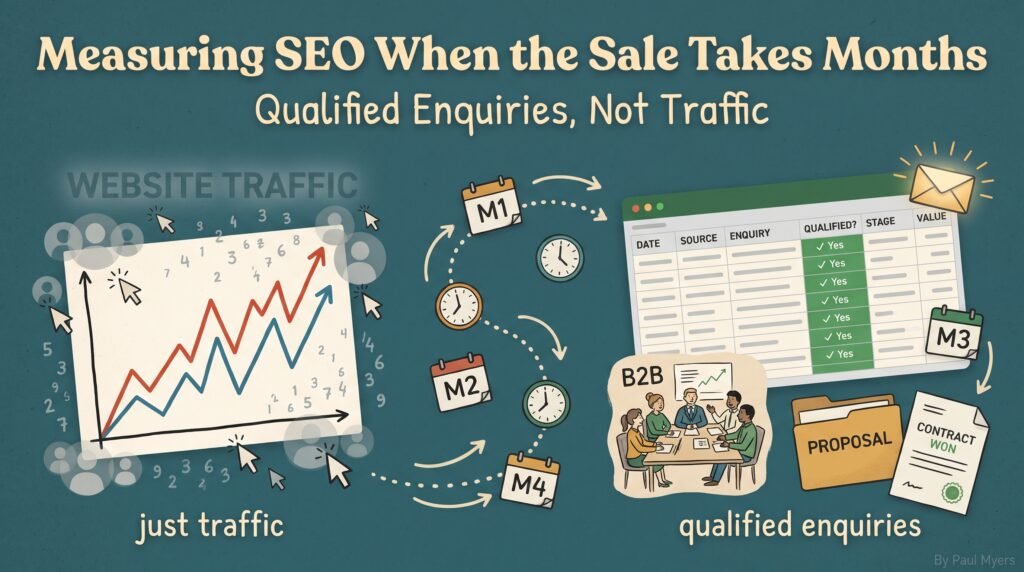
For businesses selling projects, retainers or other considered services, I’d rather measure SEO around qualified enquiries, meetings, proposals and projects.
Search visibility still matters, but mostly as the early signal.
Before changing anything, I’d agree what a qualified enquiry actually is, make sure the important contact actions are tracked, and keep a simple log of what came in and what happened afterwards.
That gives you something much more useful than another traffic report.
There’s a free enquiry log further down that you can download and use.
Why traffic can be misleading
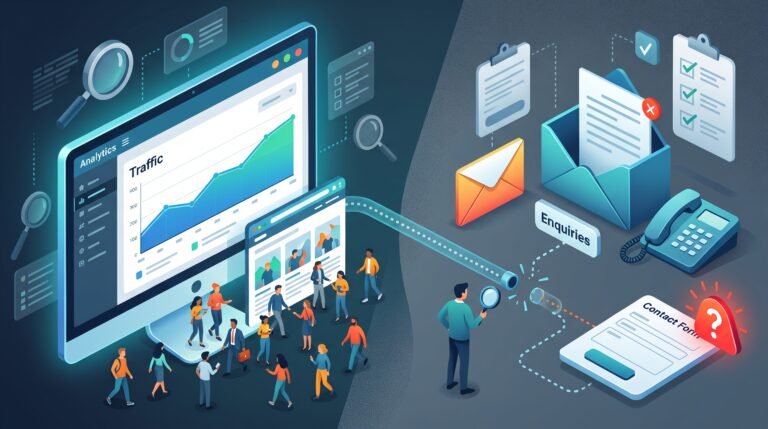
Traffic counts visits.
It doesn’t tell you whether those visitors were ever likely to buy.
A guide can suddenly bring in hundreds of extra visits from students, researchers or people looking for a free answer. That looks good in Analytics, but it may do absolutely nothing for the business.
The opposite happens too.
A page can lose a lot of low-value traffic while the number of genuinely useful enquiries stays the same.
And with a long sales cycle, the timing is messy anyway. Someone might first find you through Google, come back directly a few weeks later, mention you to a colleague, then finally get in touch by email.
Trying to line up this month’s traffic with this month’s sales usually tells you less than people think.
Decide what a qualified enquiry means first
This sounds obvious, but it’s one of the most useful things you can do.
Write down what a good enquiry looks like.
That might include:
- the type of project
- minimum or typical project value
- location
- timescale
- company size
- whether the person can make or influence the decision
I’d keep the classification simple:
- qualified
- not qualified
- unsure
Don’t over-engineer it.
After the first ten or so enquiries, you’ll probably realise the definition needs adjusting anyway. Real enquiries tend to expose the gaps quite quickly.
Track the things that show someone wants to talk
For most service businesses, I’d want the obvious contact actions recorded in GA4:
- form submissions
- phone clicks
- email clicks
- meeting bookings
The important bit is making sure the event reflects the action actually happening.
For a form, for example, I’d rather track the successful send or thank-you state than the click on the submit button. Otherwise failed submissions can get counted as leads.
For phone-heavy businesses, a click on the number is useful. If calls really matter, proper call tracking may be worth adding later.
And if you use a consent banner, remember GA4 will miss some people who decline tracking. That’s normal. It’s one reason I never rely on Analytics alone.
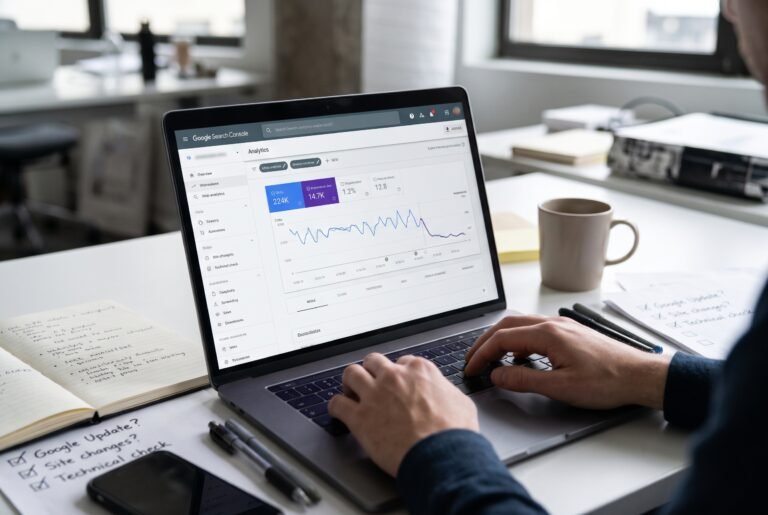
Search Console gives you another view because it isn’t dependent on the visitor accepting analytics cookies.
Keep an enquiry log as well
Analytics can’t tell you everything.
It won’t reliably capture the referral from an old client who emailed you directly. It may not know that someone found you in ChatGPT. It won’t tell you whether a form submission eventually became a £60,000 project.
That’s where a simple enquiry log helps.
I’ve made one you can use here: download the enquiry log template.
I’d keep one row per enquiry and record:
| Column | Why I’d keep it |
|---|---|
| Date | So you can review it by month |
| How it arrived | Form, phone, email, referral, LinkedIn, directory, AI assistant or something else |
| Company/contact | Useful for follow-up and spotting repeat enquiries |
| What they wanted | Shows which services are attracting useful demand |
| How they found you | Often the most useful field of all |
| Qualified? | Yes, no or unsure |
| Stage | New, meeting, proposal, won, lost or on hold |
| Value | Rough estimate of what the opportunity is worth |
The “how did you find us?” field is worth asking every time.
People will often tell you things no attribution report can.
“I searched for a .NET company.”
“Someone recommended you and then I Googled you.”
“I asked ChatGPT for suppliers.”
That information is gold because it tells you how real buyers actually discover the business.
What progress usually looks like
The signals tend to arrive in stages.
First, I’d expect movement in search visibility.
That might mean better impressions, stronger positions, more visibility for the pages and searches we actually care about, and potentially better visibility in AI answers too.
Then I’d look for enquiry signals.
Are more of the right people visiting those pages? Are form submissions, calls or email clicks increasing? Are the enquiries becoming more relevant?
Then come the business outcomes:
- meetings
- proposals
- projects won
- project value
That last stage takes longer, especially if the sale itself takes months.
This is why I wouldn’t promise a fixed number of leads in a fixed number of weeks.
Three months can be a sensible first point to judge whether the direction looks right. It is not a reliable deadline for winning a certain number of projects.
What I’d report each month
I’d keep it fairly short.
I’d want to know:
- how many qualified enquiries came in
- where they came from
- meetings and proposals
- which pages and searches are gaining useful visibility
- what changed on the site that month
- what we’re doing next
That “what changed” bit matters.
If a page was rewritten on 12 June, record it.
If a redirect went live on 3 July, record it.
If a new service page launched in August, record it.
Otherwise, six months later you end up looking at a graph and guessing what might have caused the movement.
A real example
I recently investigated a site where organic traffic had fallen and the obvious question was whether that had reduced bookings.
The problem was that nobody could answer it.
Analytics hadn’t been recording properly for almost two years. Form submissions weren’t tracked. Phone taps weren’t tracked. There was no reliable history connecting site activity to enquiries.
So before recommending content, page changes or anything else, the first job was fixing the measurement.
The driver training traffic investigation goes through the example in more detail.
That experience reinforced something I already believed: on a new engagement, one of the first questions should be how enquiries actually reach the business and what happens to them afterwards.
Not “which keywords do you want to rank for?”
The short version
If your sales cycle takes months, don’t judge SEO on traffic alone.
Agree what a qualified enquiry looks like.
Track the important contact actions.
Keep a simple enquiry log.
Then watch the progression from visibility, to enquiries, to meetings, proposals and projects.
That gives you a much better chance of knowing whether SEO is actually contributing to the business, rather than just making a graph go up.
If you sell software development or another considered B2B service, my SEO for software development companies page explains how I approach that kind of work. You can also request a free assessment or get in touch.
FAQ
What is a qualified enquiry?
It’s an enquiry from a business that fits the work you want: the right type of project, a realistic size and timescale, and someone who can make or influence the decision. You write the definition yourself before you start, then mark each enquiry qualified, not qualified or unsure.
How do I track phone calls from my website?
Start by recording clicks on phone number links as events, and mark the important ones as key events. If most of your business arrives by phone, a call tracking number can show which pages and sources lead to calls. Either way, put each call in your enquiry log.
How long does SEO take to produce enquiries for a B2B company?
There isn’t a reliable number of weeks. Visibility on your target searches usually moves first, then enquiries, then meetings and projects, with a long sales cycle adding time. I’d agree what to watch each month and treat three months as a first review point, not a deadline.
Can I measure SEO without analytics?
Partly. Search Console shows impressions, clicks and positions without analytics, and an enquiry log records where each enquiry came from. What you lose is the link between a visit and an enquiry on your own site, which is why I’d set up event tracking as well.
Which analytics events matter for a B2B website?
Successful form submissions, clicks on phone numbers, clicks on email addresses and meeting bookings. Mark the ones that show real interest as key events. I’d only add file downloads if they signal buying interest, like a pricing or capability document.
Sources
- About key events, Google Analytics Help, accessed 21 October 2026. Supports: the definition of a key event and that any collected event can be marked as one.
- Paul Myers, traffic investigation for a local driver training business, 2026 (client details withheld). Supports: the tracking example.
- Paul Myers, enquiry log template, 2026. A spreadsheet with drop-downs and a summary tab, available from this page.