Somebody searched for this and landed on my site last week, which is how I know the question is being asked in those words. It’s a fair thing to want to know, and it’s harder to answer than the same question about ChatGPT.
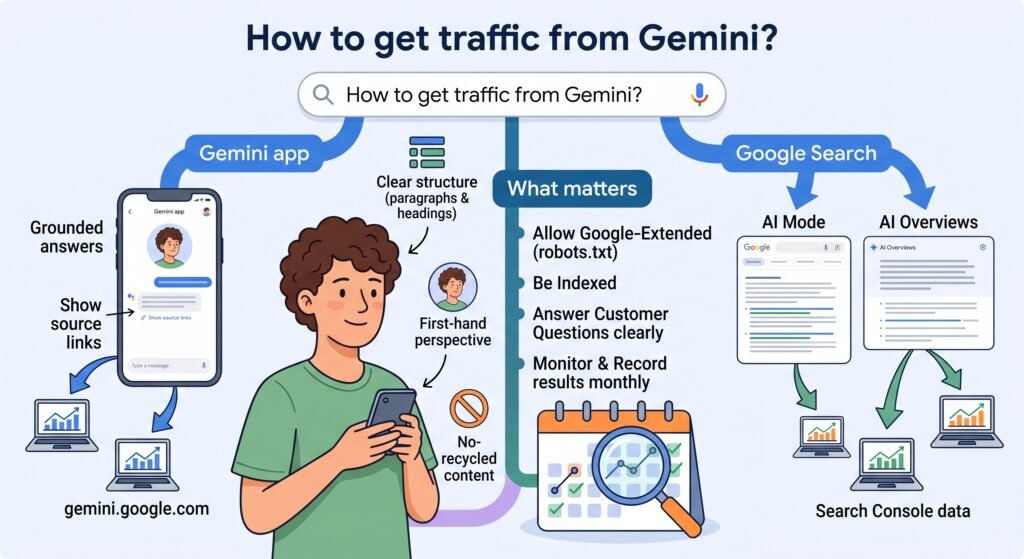
The difficulty is that Gemini is several products sharing a name. There’s the Gemini app, where somebody types a question into a chat window. There’s AI Mode and AI Overviews in Google Search, which use Gemini models but are Search products and are reported as Search. And there’s the Gemini API that developers build on. Only some of them can send you a visitor, and they’re measured in different places.
Most of what follows is about the app, because that’s usually what people mean when they ask.
The setting that decides whether you can be a source
I’d start here, because it’s the one part of this with a documented answer, not an inference.
Google publishes a robots.txt product token called Google-Extended. The crawler documentation, last updated 14 July 2026, says it lets publishers manage whether content Google crawls “may be used for training future generations of Gemini models”. It covers training for Gemini Apps and the Vertex AI API. It also covers grounding in Gemini Apps and Grounding with Google Search on Vertex AI.
That second part is worth reading twice. Grounding is how the app answers using current web content instead of what the model absorbed during training. Disallowing Google-Extended doesn’t only opt you out of training. It opts you out of being usable as a source in grounded answers.
The same page is clear that this costs you nothing in Search: “Google-Extended does not impact a site’s inclusion in Google Search nor is it used as a ranking signal in Google Search.”
So these are two separate decisions and you can take them separately. Keeping your content out of AI training is a reasonable position to hold, and if that’s what you want, this is the cost of it. If you’d rather be eligible to appear, the line needs to come out. What I’d avoid is having that decision made by accident, which is possible if the file was last edited during the wave of publishers adding AI crawler rules in 2024 and nobody has looked since.
Go and read your own robots.txt before anything else on this page. It takes a minute and it’s the only part of this you can settle with certainty.
What gets a page used as a source
Past the crawler setting, I can tell you considerably less.
Google hasn’t published how Gemini selects between candidate sources when it grounds an answer. There’s no equivalent of the ranking documentation for Search. What Google does say, in its AI optimisation guide updated 10 July 2026, is that no special files, markup or writing style are needed for its AI features, and that what helps is the ordinary list: clear heading structure, content that isn’t recycled from elsewhere, first-hand perspective, pages that are indexed and snippet-eligible.
Grounded answers draw on Google Search. So being findable in Search is very likely the entry requirement, in the way it is for AI Overviews. That’s a reasonable inference, and I’d hold it as one. Google has not confirmed it.
If I were sequencing the work: allow Google-Extended, confirm in Search Console that the pages you care about are actually indexed, and make sure each one answers the question somebody would ask in terms a reader could act on. I can’t tell you how much each of those contributes, because nobody outside Google can measure that.
Finding out what it currently says about you
This is the part most worth doing, and it doesn’t depend on anything above being right.
Write down ten to fifteen questions a customer would genuinely ask before buying from you, in the words they’d use. Run them in the Gemini app. Record whether you’re named, whether the description is accurate, and which sources it cited instead of you.
Do it more than once, on different days. Answers vary between runs, so a single result tells you very little and a screenshot tells you less. What you’re building is a record you can compare against in three months.
If a competitor comes up and you don’t, that’s worth understanding before assuming there’s a technical fix. Look at what the cited sources actually contain. Often they answer something specific that nobody else bothered to write down.
Whether any of it sends visitors
The app shows source links in grounded answers, so a click is possible. In analytics it arrives as referral traffic from gemini.google.com.
Look at your own rather than take a number from me. In GA4, filter Traffic acquisition by session source containing the assistant domains. Set it up now even if the figure is currently zero, because you can’t backfill a trend you never recorded. On the properties I look at, these numbers are small, but they vary by sector and I wouldn’t treat my accounts as a guide to yours.
AI Mode and AI Overviews are a separate measurement problem. Those are Search, so clicks land inside your normal Search Console performance data under the Web search type, with no breakdown that isolates them. That limitation is Google’s design and there’s no workaround. I’ve written about what you can still infer in measuring whether AI search is costing you traffic.
What I’d say about volume is that the case for this work rests on being named to somebody who is choosing, not on the referral count. If your business case needs measurable sessions from Gemini this quarter, check the referral figure first and decide from that, because it’s the number you’d be betting on.
What I’d do
Check robots.txt for Google-Extended and make the decision deliberately.
Confirm the pages you care about are indexed, in Search Console, not by assumption.
Write the question list, run it, record the answers, and repeat monthly.
Set up the referral segment so a trend exists later.
That’s the same method I’d use for any assistant, and there’s more on how I do it at AI search visibility. For how the platforms differ, AI search in the UK covers all five.
FAQ
Does Gemini send traffic to websites?
It can. Grounded answers in the Gemini app show source links, and clicks arrive in analytics as referrals from gemini.google.com. Check your own figure in GA4 by filtering session source, because volumes vary by sector. Clicks from AI Mode and AI Overviews are separate, and appear inside normal Search Console data.
Does blocking Google-Extended stop me appearing in Gemini?
For grounded answers, yes. Google’s crawler documentation says Google-Extended covers both training and grounding in Gemini Apps, so disallowing it opts you out of being used as a source. It doesn’t affect Google Search: Google states it isn’t a ranking signal and doesn’t affect inclusion.
Is Gemini the same as AI Overviews?
No, though they use related models. AI Overviews and AI Mode are Google Search features and their clicks are reported in Search Console. The Gemini app is a separate product, and its source links appear in analytics as ordinary referral traffic.
How do I get Gemini to recommend my business?
Nobody outside Google can tell you the selection criteria, because it hasn’t been published. What you control is being crawlable, allowing Google-Extended, being indexed, and answering your customers’ actual questions clearly. Then test those questions monthly and record what changes, so you’re working from your own evidence.
Should I write differently for Gemini?
Google’s AI optimisation guide says you don’t need to write in a specific way for generative AI search, because these systems understand synonyms and meaning. Clear structure and answers near the top of a section help readers, and that’s a sound enough reason on its own.
Sources and method
- Google crawlers overview, Google Search Central, last updated 14 July 2026, accessed 25 September 2026. What
Google-Extendedcontrols, including grounding in Gemini Apps and Grounding with Google Search on Vertex AI, and the statement that it doesn’t affect inclusion or ranking in Google Search. - Top ways to ensure your content performs well in Google’s AI experiences on Search, Google Search Central, last updated 10 July 2026, accessed 25 September 2026. No special files, markup or writing style needed, and the list of things that do help.
- AI features and your website, Google Search Central, last updated 10 December 2025, accessed 25 September 2026. AI feature links reported within normal Search Console performance data.
On what isn’t sourced. Google hasn’t published how Gemini selects sources when grounding an answer. The suggestion that Search findability is the entry requirement is an inference from its Search guidance, and is labelled as one in the text. Referral volumes are described as described as varying by sector instead of given as a figure, because the accounts I see are not a representative sample.