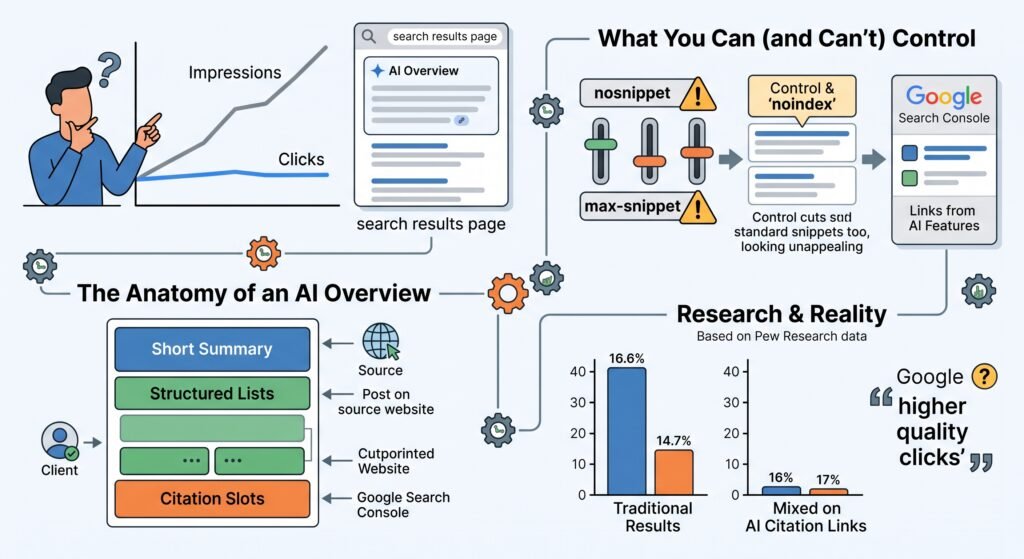
A client rang me earlier this year because their Search Console impressions were climbing and their clicks weren’t. Nothing had gone wrong technically. Their rankings hadn’t moved. What had changed was the shape of the results page for a chunk of their queries, and an AI Overview was sitting above everything they’d worked to earn.
That’s a common enough starting point, and it usually comes with a reasonable question attached: what is that box, where does it get its information, and is there anything I can do about it?
This piece answers the first two. The practical steps are in a separate post on appearing in Google AI Overviews, and I’d rather link to that than repeat it here. What I want to set out is what Google has actually documented about how these are built, what one looks like when you measure it, and what the click research does and doesn’t show.
Where AI Overviews came from
Google announced Search Generative Experience, or SGE, at I/O in May 2023, as an opt-in experiment in Search Labs. In May 2024 it introduced AI Overviews as the name for AI answers in Search, and they reached the UK that August. Availability widened to over a hundred countries by October 2024 and past two hundred by May 2025. AI Mode arrived as a test in March 2025.
I mention the dates because they affect what you can trust. A lot of guidance written in 2023 and early 2024 was describing an opt-in experiment with a fraction of the current reach, and some of it is still circulating unchanged. If a document calls the feature SGE, it was written before May 2024.
The feature hasn’t only expanded. It’s also been pulled back under pressure more than once. Google restricted AI Overviews on some health searches in January 2026 following a Guardian investigation, and there was a well-documented episode in May 2024 where the feature produced obviously unsafe suggestions and was pulled back. There’s also a European Commission competition investigation opened in December 2025. None of that helps you optimise for it. It does show that the product is still being changed in response to pressure, which is worth knowing before you build a strategy around its current behaviour.
What Google says is happening underneath
The most useful document here is AI features and your website in Google Search Central, last updated 10 December 2025. It’s short, and it’s more specific than most of what’s written about it.
The parts that bear on how sources get chosen are query fan-out and the absence of any separate entry route.
Query fan-out comes first. Google describes AI features issuing “multiple related searches across subtopics and data sources” instead of answering from the single query you typed. Google’s own framing is that this surfaces “a wider and more diverse set of helpful links” than a conventional results page would. The AI Mode announcement from May 2025 describes the same technique, “breaking down your question into subtopics and issuing a multitude of queries simultaneously on your behalf”, and says a custom version of Gemini 2.5 sits behind both AI Mode and AI Overviews.
Then there’s the entry route, or the lack of one. Google states there are “no additional requirements to appear in AI Overviews or AI Mode, nor other special optimizations necessary”, and that you don’t need new machine-readable files, AI text files or special schema markup. The systems draw on Search, so the page has to be indexed and snippet-eligible, and that’s the qualification.
Put those together and you get a reasonable working model: your page earns its place in Search in the ordinary way, and then a question that gets broken into several sub-questions may pull it into an answer, including for a query it doesn’t rank for directly. It’s a working model, not a mechanism I can prove from the outside. Google hasn’t published the retrieval detail, and I can’t observe it.
One more line from that document is worth quoting because it’s Google’s own claim about value: “when people click from search results pages with AI Overviews, these clicks are higher quality.” Google hasn’t published the data behind that, so I’d read it as a company describing its own product. It isn’t a published finding. The click research below points the other way on volume. Quality and volume are separate questions, and Google has answered the one it hasn’t shown the working for.
How AI Mode differs
AI Mode is the version where the whole result is generated, with follow-up questions, instead of an answer sitting above a conventional results page. Google’s documentation is careful to say that AI Mode and AI Overviews “may use different models and techniques, so the set of responses and links they show will vary”.
I read that as a warning against testing one surface and assuming the other behaves the same way. A supplier claiming a single method covers both is going further than Google has. When I check these things I check them separately, and I’d expect anyone reporting on AI visibility to say which surface they measured.
What one actually looks like when you measure it
On 24 September 2026 I pulled five live UK commercial searches and recorded what the AI Overview contained. Three came back complete enough to analyse. This is a spot check, not a study, and I wouldn’t generalise from three results.
| Search | Words in the overview | Content blocks | Citation slots | Unique domains cited |
|---|---|---|---|---|
| best accounting software for small business uk | 224 | 7 | 12 | 6 |
| how much does a website cost uk | 239 | 8 | 14 | 7 |
| best crm for small business uk | 170 | 4 | 14 | 7 |
Some observations, held loosely given the sample size.
They’re short. Between 170 and 239 words, which is less than a page of a document and a good deal less than the articles being cited. Whatever the overview does, it isn’t reproducing the source.
They’re structured, not prose. Across the three, the blocks were a mix of paragraphs, headings and lists, and lists appeared in all three. That’s consistent with the idea that clearly segmented content is easier to summarise, though I can’t establish cause from this.
The citation slots outnumber the sources. Twelve to fourteen citation slots resolved to six or seven distinct domains, because the same source gets cited at several points in the answer. If you’re counting citations as a visibility measure, count domains and pages separately, or you’ll overstate how many businesses are represented.
The fifth search, “commercial cleaning services Liverpool”, returned no AI Overview at all. Local commercial intent still produced a map pack and ordinary results. That’s one query on one day, but it’s a reminder to check the searches that actually bring you enquiries before assuming this applies to you.
What the click research shows, and what it doesn’t
Two pieces of published research are worth knowing about, and they come from the same team.
Pew Research Center published a study in July 2025 using one month of browsing data from 900 US adults, collected in March 2025. It found that users clicked a traditional result in 8% of searches where an AI summary appeared, against 15% where one didn’t. Clicks on links inside the summary were rarer still, at about 1% of visits. Around 58% of the panel saw at least one AI summary that month.
The same researchers published a fuller analysis in August 2026, using mixed-effects logistic regression on that data. It reports the same roughly 1% click rate on cited sources, finds AI Overviews associated with fewer clicks and a higher chance of ending the browsing session, and finds that longer queries, questions and queries containing both nouns and verbs are more likely to produce an overview.
Before anyone quotes those numbers at you, the limits are worth knowing.
It’s US data, from a 900-person panel, gathered in March 2025. Search behaviour and the feature itself have both moved since. It’s also association, not proof of cause: pages that trigger an AI Overview tend to be informational questions, and informational questions had lower click-through rates before AI Overviews existed. The research authors are measuring what happens on those pages, not isolating the effect of the box.
Google has publicly disputed the Pew findings. I’d note the dispute and also note that Google hasn’t published contradicting data, which leaves you with one measured study and one company’s characterisation.
Where does that leave a UK small business? With a reasonable expectation that on informational queries, fewer people will click through than used to, and with no reliable public figure for how much. That’s why I’d rather measure the effect on your own site, which is what the next post in this series covers.
What you can actually control
Google’s documentation is specific about the controls, and they’re the ordinary Search ones and not anything AI-specific:
nosnippet,data-nosnippetandmax-snippetlimit what can be shown from a page, including in AI features.noindexremoves the page from Search altogether, and therefore from AI features.- Robots.txt governs Googlebot’s crawl access.
Google-Extendedis a separate control covering AI training and grounding in Google’s other AI products, not Search.
I’d be careful with all of these. nosnippet and a tight max-snippet will reduce your exposure in AI Overviews, and they’ll also cut your ordinary search snippet, which is usually a worse trade than the problem it solves. I’ve not yet seen a small business case where I’d recommend it. If you’re considering it, the question I’d ask first is whether you can measure what the overview is currently costing you, because otherwise you’re trading a known asset for an unknown gain.
Links shown in AI features are reported inside your normal Search Console performance data, under the Web search type. There’s no separate AI Overviews report, which is the main practical frustration when you try to size the effect.
What this tells you about ChatGPT, Claude and Perplexity
Very little.
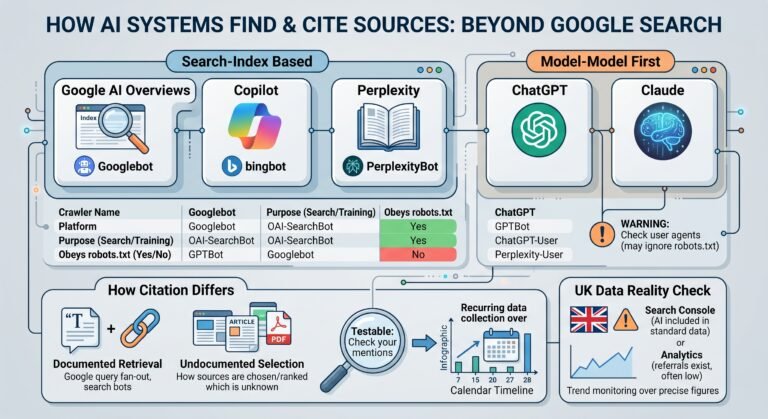
Everything above is Google documenting Google. ChatGPT, Claude, Perplexity and Copilot use different crawlers, different retrieval and different citation behaviour, and none of them has published anything as specific as Google’s AI features document. Work that earns you a place in Google’s index is a reasonable foundation for all of them, because most of them retrieve from the web in some form. That’s an inference, not a documented fact, and I’d hold it as one.
What I’d do
If you’re in the position my client was in, with impressions up and clicks flat, I’d work through it in this order.
Find out which of your queries actually produce an AI Overview. Not the ones you’d guess, the ones that bring enquiries. Informational and question-shaped queries are the most likely candidates, per the 2026 research, and commercial local searches may well show nothing at all.
Then separate the pages where the overview is answering the whole question from the pages where it can’t. A price range or a definition can be summarised in 200 words. A treatment comparison, a specification or anything that depends on your particular circumstances usually can’t, and those pages tend to hold up better.
Then measure it properly before changing anything, which is a big enough subject to have its own post. Impressions against clicks at the page level, over a period long enough to rule out seasonality.
I do this work with clients, and the measurement almost always takes longer than the fix. If you want that side of it, there’s more at AI search visibility, and the mechanics across platforms are in the AI search guide.
FAQ
What is an AI Overview?
An AI Overview is a generated summary that Google shows above search results for some queries, with links to sources. Google introduced them in May 2024, replacing the name Search Generative Experience, and they reached the UK in August 2024. They draw on Google’s existing Search systems, which is where a page has to earn its place first.
How does Google choose which sites to cite?
Google hasn’t published the retrieval detail. What it has documented is query fan-out, where a question is broken into subtopics and multiple related searches run at once, and that pages must be indexed and snippet-eligible. That means a page can be cited for a sub-question even when it doesn’t rank for the query typed.
Do I need special markup to appear in AI Overviews?
No. Google states there are no additional requirements, and no need for machine-readable files, AI text files or special schema.org markup. The qualification is ordinary Search eligibility: the page has to be indexed and able to show a snippet.
What is the difference between AI Overviews and AI Mode?
AI Overviews appear above a conventional results page. AI Mode generates the whole result and supports follow-up questions. Google says the two may use different models and techniques, so the responses and links they show will vary, which means testing one tells you little about the other.
Are AI Overviews reducing clicks?
Published research suggests fewer clicks on queries where they appear. A Pew study of 900 US adults, using March 2025 data, found a traditional result was clicked in 8% of searches with an AI summary against 15% without. It’s association rather than proven cause, it’s US data, and Google disputes it.
Can I stop my site appearing in AI Overviews?
Partly. nosnippet, data-nosnippet and max-snippet limit what Google can show from your page, and noindex removes it from Search entirely. All of them also reduce your ordinary search snippet, so the cost is usually higher than the benefit. Measure what the overview is costing you first.
Sources and method
- AI features and your website, Google Search Central, last updated 10 December 2025, accessed 24 September 2026. Query fan-out, no additional requirements or special files and markup, publisher controls, Search Console reporting, and Google’s “higher quality” clicks statement.
- AI Mode in Google Search, Google, published 20 May 2025, accessed 24 September 2026. Query fan-out described for AI Mode, and the custom Gemini 2.5 model behind AI Mode and AI Overviews.
- Top ways to ensure your content performs well in Google’s AI experiences on Search, Google Search Central, last updated 10 July 2026, accessed 24 September 2026. Background on what Google says does and doesn’t help.
- Google users are less likely to click on links when an AI summary appears in the results, Pew Research Center, published 22 July 2025, accessed 24 September 2026. The 8% against 15% click figures, the 1% figure for links inside summaries, and the 900-adult March 2025 panel.
- Investigating Click Behaviors On Google Search Result Pages That Produce an AI Overview, Athena Chapekis, Anna Lieb, Sono Shah and Aaron Smith, arXiv:2608.04831, submitted 5 August 2026, accessed 24 September 2026. The regression analysis, the roughly 1% citation click rate, the association with ending sessions, and the query characteristics that predict an overview.
- AI Overviews, Wikipedia, accessed 24 September 2026. Secondary source for the SGE, AI Overviews and AI Mode timeline, the country rollout dates, and the documented incidents and investigations. Google’s original SGE announcement pages no longer resolve, so this stands in for them and should be checked against primary announcements where it matters.
- Own spot check: five live UK commercial Google searches captured 24 September 2026. Three complete AI Overviews were analysed for word count, block structure, citation slots and unique cited domains. One capture was incomplete and excluded; one query returned no overview. Raw captures and method are in the project research folder.