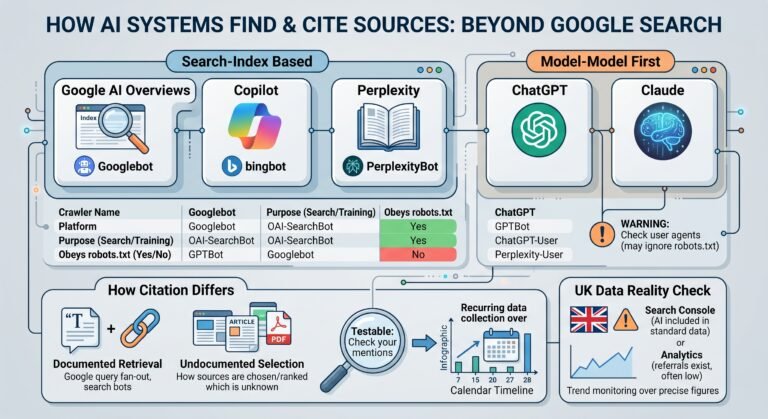
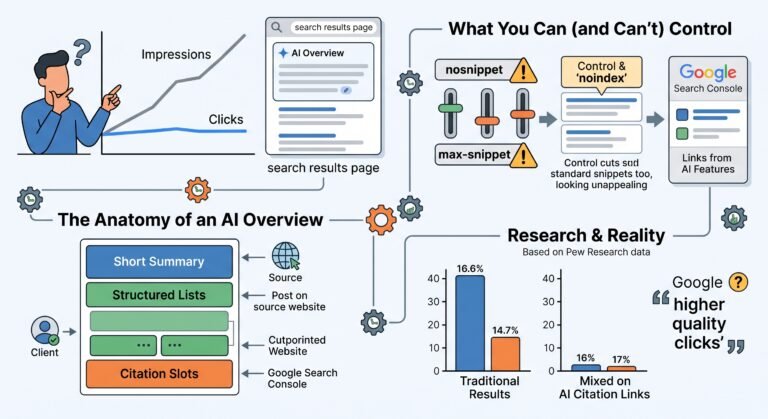
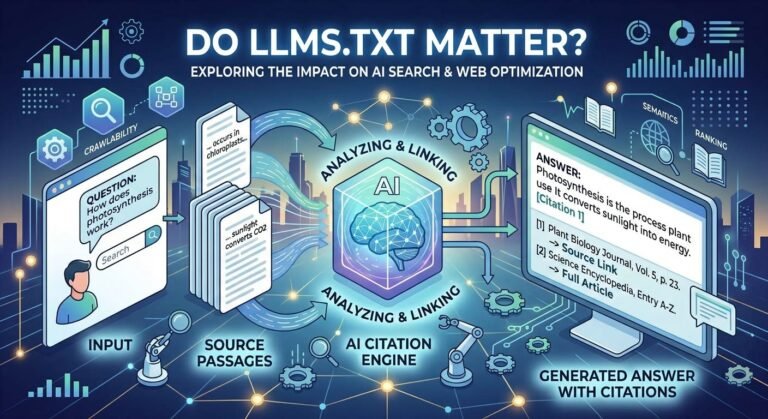
If you’ve looked at an SEO or AI search proposal lately, there’s a good chance at least one of these has appeared in it: GEO, AEO, AIO or LLMO. Sometimes all four. Each can sound like a separate discipline with a separate price attached.
I understand why the names have caught on. Search has changed, and people need a way to talk about appearing in AI answers as well as the usual search results. But the names can make fairly familiar work sound more mysterious than it is. They can also hide genuinely useful work behind a label that nobody has properly defined.
I’ve been looking at where the terms came from, what the original research actually tested, and what Google says you need to do for AI Overviews and AI Mode. If you’re trying to work out what’s worth including in a strategy, or what you’re being quoted for, that seems a better starting point than the acronym itself.
Before the acronyms, there was SGE
Google announced Search Generative Experience, or SGE, at I/O in May 2023. It was an opt-in experiment in Search Labs. In May 2024, Google introduced AI Overviews as the name for its AI answers in Search. They reached the UK that August. AI Mode arrived as a test in March 2025.
The dates matter because some advice still circulating was written when SGE was an experiment. The interface, reach and behaviour have changed since then. If somebody’s current strategy still calls the feature SGE, I’d ask when they last reviewed it. The term alone doesn’t prove the advice is wrong, but it gives you a reason to check.
It also shows why I’m cautious about very precise promises. We’ve moved from SGE to AI Overviews and then AI Mode in a short space of time. The research from 2023 was looking at a different environment from the one your customers see now. There are useful principles we can take from it; there isn’t a permanent playbook.
Where did GEO, AEO, AIO and LLMO come from?
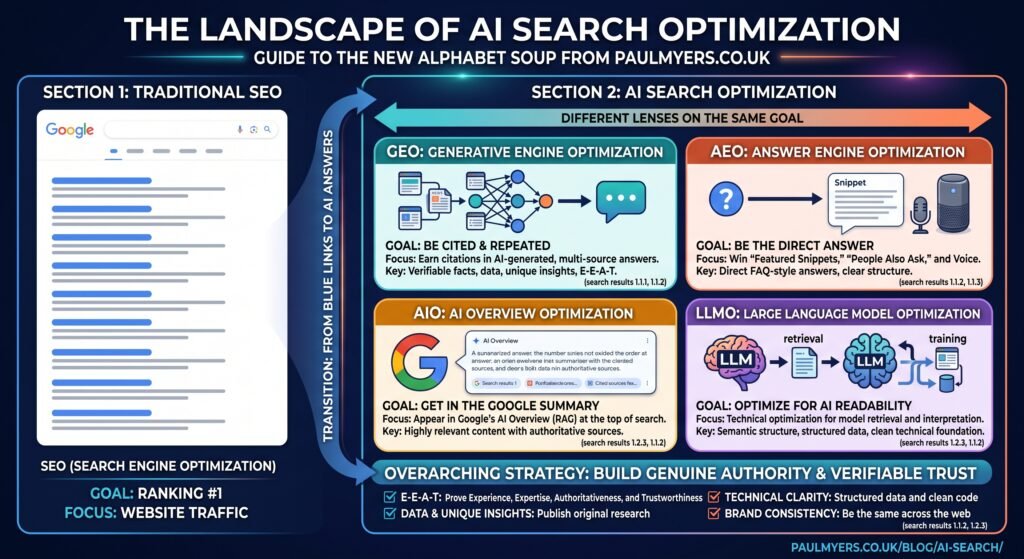
GEO has a reasonably clear origin in a research paper submitted in 2023. AEO is older industry language associated with featured snippets and voice search. AIO and LLMO have less settled meanings. These are industry terms, rather than names Google gives to separate sets of optimisation requirements.
| Term | Meaning | Where it came from | Google’s term? |
|---|---|---|---|
| SEO | Search engine optimisation | Industry usage since the late 1990s | Yes, used in its documentation |
| SGE | Search Generative Experience | Google’s Labs experiment, announced May 2023 | Formerly; the feature became AI Overviews |
| GEO | Generative engine optimisation | Research submitted to arXiv in November 2023 and accepted to KDD 2024 | No |
| AEO | Answer engine optimisation | Industry usage around featured snippets and voice search, particularly from 2018 onwards | No |
| AIO | Several meanings, explained below | Industry usage with no single agreed origin | No |
| LLMO | Large language model optimisation | Industry usage with no single agreed origin | No |
I don’t object to new names on principle. SEO itself is an industry label. What I question is the suggestion that each acronym gives you a new technical lever to pull. Sometimes the work underneath is useful. Sometimes it is the same work your SEO and content team should already be doing.
AIO needs a definition before it needs a budget
Of the four, AIO is the one I’d avoid putting into a proposal without spelling it out. I see it used in three ways:
- AI optimisation: a broad label for work across assistants and AI search products, such as ChatGPT, Gemini and Perplexity.
- AI Overview optimisation: work aimed at Google’s AI Overviews specifically.
- AI Overviews: shorthand for the feature itself, rather than a service.
That could mean very different scopes. If a supplier says they’ll handle AIO and you take it to mean visibility across several assistants, while they mean Google’s AI Overviews, you’re discussing different projects. Neither side necessarily meant to mislead the other. The abbreviation just isn’t doing its job.
I’d ask them to write out exactly what they mean and which platforms are included. Personally, I use AI Overviews for Google’s feature and AI search visibility for the broader work. It takes a few extra letters and saves a fair bit of confusion.
GEO: good research, stretched a little too far
GEO is the one with an academic paper behind it. Aggarwal and colleagues submitted GEO: Generative Engine Optimization in November 2023; it was accepted to KDD 2024. The headline result was that certain changes to content improved its visibility in generative answers by up to 40% in their experiments.
I’ve seen that 40% figure in a lot of sales material. The part usually missing is what was actually measured.
The researchers used GEO-bench, a benchmark they built, and tested against generative engines in their experimental setup. They weren’t measuring Google AI Overviews. The paper predates the AI Overviews launch, and SGE was still an opt-in experiment when it was submitted. The authors also found that different techniques worked better for different subject areas. Even within the study, there wasn’t one universal trick.
The stronger techniques included adding citations, statistics and quotations. Those aren’t exotic changes. They’re ways of making a page more specific and better supported. I’d want them in a good article whether or not an AI system ever quoted it.
So I take the paper seriously, but I wouldn’t put “up to 40% more AI Overview visibility” in a client forecast on the strength of it. That is a different claim, about a different product, at a different point in time. The interesting lesson is narrower: giving an answer evidence and useful detail may make it a better source for a generated response. How much that helps on your own site still has to be tested.
AEO: useful writing, familiar work
Answer engine optimisation sounds new, but the underlying idea is familiar to anyone who worked on featured snippets. Give the reader a clear answer they can understand on its own, then develop the explanation underneath. People were doing that for snippets and voice search years before AI Overviews appeared.
I still think it’s a good way to write. If a page answers a specific question, don’t make someone work through six paragraphs of scene-setting to find the answer. State it, then give them the exceptions, the detail and the evidence they need to make sense of it.
That can also help a system pick out a useful passage. You can’t decide exactly which 40 words an AI answer might use, but you can give it something accurate and self-contained to work with.
Would I pay a separate AEO fee for adding an answer near the top of a page? Probably not. I’d expect that to be part of a proper content brief or page rewrite. If the proposal includes research, testing and improvements beyond that, I’d look at those deliverables rather than the label.
LLMO: ask what somebody will actually do
Large language model optimisation, or LLMO, generally means trying to improve how your business appears in tools such as ChatGPT, Claude, Gemini and Perplexity. Unlike GEO, it doesn’t point back to one agreed piece of research or a settled method. People use it to describe quite different things.
That doesn’t make visibility in those tools imaginary. If customers ask an assistant for a recommendation in your market, what it says about you is worth knowing. You can test recurring questions, record whether you’re mentioned, check whether the information is accurate, and investigate which sources the assistant appears to be using. You can then improve the parts you control.
But if someone offers “LLMO” as a line item, I’d ask for the work in plain English. Which questions will they test? How often? Which platforms? What will they change, and what would count as an improvement? Those are answerable questions. The acronym alone isn’t a deliverable.
An interactive version of this
If you’d rather click through the terms than read about them, I’ve built the argument in this article as an interactive map: the AI search acronym map.
It has four views. A map of how the terms relate, a walkthrough of what happens when someone asks an AI system a question, a comparison table showing how much of each discipline is ordinary SEO underneath, and an eight-point readiness scorecard for your own site.
Two things it deliberately does not do. It doesn’t present a diagram of how Google works, because no platform publishes that, so where a panel describes a mechanism it says it’s inference. And the query walkthrough uses placeholder names, because inventing citations from real companies would be the exact thing this article argues against.
It’s free to embed if it’s useful. There’s a button at the bottom of the tool that copies the code.
What Google actually says about AI search
There are two Google Search Central documents I’d read before paying for a new AI-specific tactic: AI features and your website and Top ways to ensure your content performs well in Google’s AI experiences on Search. They make a fairly straightforward point. Google doesn’t set additional technical requirements for appearing in AI Overviews or AI Mode beyond the usual eligibility for Search.
In the first document, Google says there are “no additional requirements to appear in AI Overviews or AI Mode, nor other special optimizations necessary”. It also says you don’t need new machine-readable files, AI text files or special schema markup for those features.
The second guide deals with several of the tactics now being sold:
- Special files and Markdown: Google says Search doesn’t use these for this purpose; adding them won’t help or hurt visibility.
- Splitting content into tiny chunks: Google says there’s no requirement to do this so AI can understand it.
- Writing in an artificial AI-friendly style: Google says you don’t need a special way of writing just for generative AI search.
- Manufactured mentions: Google cautions that inauthentic mentions around the web aren’t as useful as they may sound.
I wouldn’t read that as “there’s nothing to do”. The same guidance points to clear structure, distinctive and first-hand content, useful images and video, pages Google can index and show snippets from, sound HTML, reasonable performance, and an accurate Google Business Profile where relevant. Some sites need a lot of work on precisely those things.
There’s an important limit here: these are Google’s documents. They tell us about Google Search, not everything that goes into ChatGPT, Claude or Perplexity. I’d be careful with a supplier claiming one set of rules works identically across all of them. Equally, I wouldn’t assume good website and content work stops mattering the moment the interface becomes a chatbot.
Four claims I’d check before signing anything
Certain recommendations keep turning up in AI search proposals. Here’s how I’d approach them.
“You need an llms.txt file.” Google says its Search systems don’t use AI text files for AI Overviews or AI Mode, and that having one won’t help or hurt. I’ve covered llms.txt in more detail. There may be a limited use for a file like this in your own workflows, but I wouldn’t buy it as a Google visibility tactic. Claims about what every other assistant does should be checked separately against evidence for that assistant.
“We’ll add LSI keywords.” Latent semantic indexing is a real information retrieval technique. “LSI keywords” as an SEO shopping list is another matter. Google has rejected the idea that you need them, and its current AI guidance says you don’t need special wording for a system that can understand related language and meaning. If this appears in a new proposal, I’d ask what research actually led to those terms and why a normal content brief wouldn’t cover them.
“Prompt engineering will make assistants recommend you.” Good prompts help us test answers, analyse patterns and work on content. Your supplier can’t control the prompts your customers type. So I’d distinguish research using prompts from a promise that writing prompts will somehow alter an assistant’s recommendations. The former is useful. The latter needs an explanation and evidence.
“We know the AI ranking factors.” Google says AI Overviews and AI Mode may use different models and techniques, and the answers and links can vary. It also describes query fan-out, where a question can trigger several related searches. There isn’t a published, fixed list of AI ranking factors you can simply work through. If somebody has one, I’d want to know what they measured, on which platform and when.
I checked a few live results, too
On 24 September 2026, I looked at five UK commercial searches and compared the domains cited in their AI Overviews with the first-page organic results for the original query, which came back as nine results in each case. This was a spot check, not a representative study.
I could capture three of the overviews in full. One needed another request to expand and that request timed out, so I left it out of the counts. The fifth search returned no AI Overview. Across the three usable results, there were 20 unique cited domains: 11 also appeared in those organic results for the same query and nine did not.
| Search | Domains cited | In the organic results | Outside the organic results |
|---|---|---|---|
| best accounting software for small business uk | 6 | 3 | 3 |
| how much does a website cost uk | 7 | 5 | 2 |
| best crm for small business uk | 7 | 3 | 4 |
I wouldn’t turn three results into a universal percentage. But they illustrate two things I think are useful to keep in mind.
First, there was a lot of overlap with conventional rankings. If a page already performs well in Search, it makes sense to look at it first when investigating AI visibility. Google says these features draw on its existing Search systems.
Second, overlap wasn’t complete. Nine cited domains weren’t in the first-page organic results for the exact searches I ran. Query fan-out is one plausible explanation: Google may search for related parts of a question and find a source that isn’t prominent for the original wording. I can’t prove that’s what happened for each citation from this spot check alone. It does suggest that judging AI visibility solely by your ranking for the headline query could miss part of the picture.
The query with no overview was “commercial cleaning services Liverpool”. That’s worth remembering when someone pitches AI Overview work to a local business. Some valuable searches still show a map pack and ordinary results without an AI answer. Check the actual searches that bring enquiries before deciding where the budget goes.
So what work is left?
Quite a lot, in the right circumstances. It’s just less dramatic than the acronyms make it sound.
Make sure important pages can be crawled, indexed and shown in search. Answer the customer’s question clearly. Add the experience, figures or examples that a generic article can’t provide. Show where your claims come from. Keep business information accurate across the places people and search systems find it. That is good SEO and good publishing, and Google’s guidance gives little reason to abandon it.
Then look at the work that really is specific to AI search. Which questions are people asking assistants? Does your business get named, and is the description right? Are competitors being suggested for questions you should be able to answer? What sources are being cited? Do you have a useful page for those questions, or are you leaving the assistant to piece an answer together from somewhere else?
I work on those questions with clients. They involve research, measurement and sometimes quite substantial changes to content and site structure. Calling the whole thing GEO or LLMO doesn’t tell you whether any of that work will happen.
If you want to go further into the mechanics, the AI search guide looks at how different platforms find information. I’ve also written about the practical steps for appearing in Google AI Overviews.
If a proposal uses these terms, here’s what I’d ask
What does the term mean in this proposal? If it says AIO, get the platforms and features written down. Work across several assistants is a different brief from work on Google AI Overviews.
What exactly will be delivered? Compare any AI-specific files, chunking, markup or LSI keyword recommendations with Google’s published guidance. If the plan still talks about SGE, ask when it was last updated. There may be a reasonable explanation, but the supplier should be able to give one.
How will we know if it helped? Assistant mentions for a set of agreed questions can be monitored, with the caveat that answers vary. AI referrals can be inspected in analytics where identifiable. Search Console can show changes in impressions and clicks, although it won’t neatly attribute every change to AI Overviews. Ask what a useful result would look like and what the limitations of that measure are.
Is this already in our SEO scope? There’s nothing embarrassing about the answer being yes. Clear answers, evidence and well-structured pages belong in a good SEO programme. If you’re paying for extra work, you should be able to point to what’s extra: perhaps a baseline across assistants, regular testing, source analysis or a set of new pages based on questions you hadn’t considered.
That’s the standard I’d use whether the proposal calls it GEO, AEO, AIO, LLMO or simply AI search visibility.
FAQ
What’s the difference between SEO and GEO?
SEO covers improving a site’s visibility in search. GEO usually refers to visibility within generated answers. There’s considerable overlap in the work, particularly on Google, which says AI Overviews and AI Mode have no separate optimisation requirements. Researching and measuring those answers can still be a useful addition to an SEO programme.
What happened to SGE?
SGE was Google’s Search Generative Experience, an opt-in Labs experiment announced in May 2023. Google introduced AI Overviews in May 2024, and they reached the UK that August. If you see SGE in current advice, check whether the advice itself has been updated.
Does AIO mean AI optimisation or AI Overviews?
It can mean either. Some people use it for broad AI optimisation, others for optimising for Google AI Overviews, and others as shorthand for the feature itself. I’d ask for the full wording and the platforms covered.
Is GEO real, or just marketing?
The term comes from a real research paper, and its experiments found improvements in visibility in the systems tested. The marketing sometimes takes that result further than the evidence allows. In particular, the widely quoted “up to 40%” figure wasn’t a measurement of Google AI Overviews.
Do I need llms.txt for AI search?
Google says its Search systems don’t use these files for AI Overviews or AI Mode and that creating one won’t improve or damage visibility there. If someone recommends one for a different purpose or platform, ask them to show what uses it and what result they expect.
Should I pay separately for GEO or AEO?
Look at the work rather than the name. Clear answer passages and sound page structure should normally be part of content and SEO work. Researching assistant recommendations, setting a baseline, checking sources and making targeted improvements may justify extra scope. Ask for deliverables and a sensible way to assess them.
Sources and method
- AI features and your website, Google Search Central, last updated 10 December 2025, accessed 24 September 2026. Google’s guidance on eligibility, special files and markup, differing AI features and query fan-out.
- Top ways to ensure your content performs well in Google’s AI experiences on Search, Google Search Central, last updated 10 July 2026, accessed 24 September 2026. Guidance on AI text files, content chunking, writing for AI, mentions and general content quality.
- Using generative AI content, Google Search Central, last updated 10 December 2025, accessed 24 September 2026. Background on AI-assisted content and scaled content abuse.
- GEO: Generative Engine Optimization, Pranjal Aggarwal and colleagues, submitted 16 November 2023 and accepted to KDD 2024, accessed 24 September 2026. Source for the term, benchmark, visibility result and differences between subject areas.
- AI Mode in Google Search, Google, published 20 May 2025, accessed 24 September 2026. Background on query fan-out and Google’s AI systems.
- AI Overviews, Wikipedia, accessed 24 September 2026. Secondary source for the SGE, AI Overviews and AI Mode timeline; check against Google’s announcements before publication.
- Google: LSI keywords have no effect, Search Engine Roundtable, reporting John Mueller’s statement, accessed 24 September 2026.
- Own spot check: five live UK commercial Google searches on 24 September 2026. Three complete AI Overviews were compared, by domain and deduplicated, with the first-page organic results for each original query, which returned nine results per query. One incomplete capture was excluded; one query had no overview. Raw captures and method are in the project research folder.